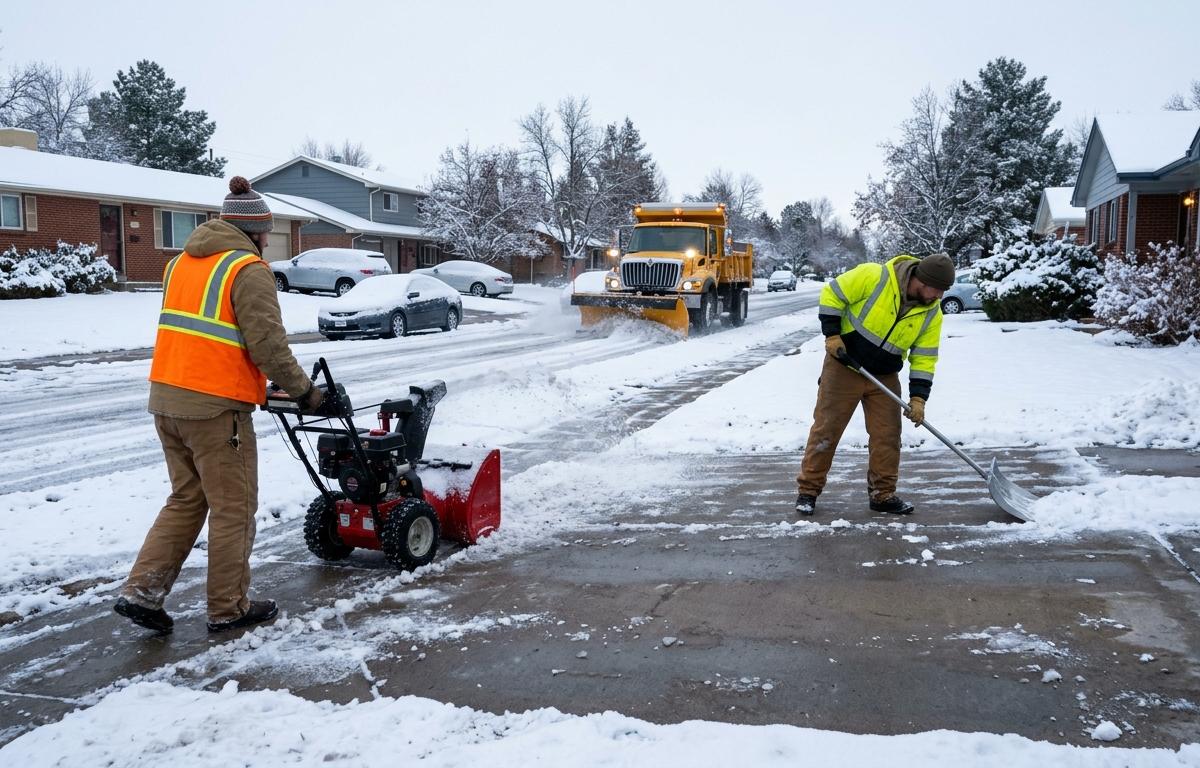
What the Denver Sidewalk Snow Ordinance Requires
If you own, occupy or rent a building or lot in Denver, the sidewalk next to it is your job to clear. Local outlets describe the denver snow removal ordinance as covering the owner, occupant or tenant of any building, property or lot, and the standard they cite is removal of snow and ice from adjacent sidewalks within 24 hours after the snow stops. 9NEWS has summarized the Colorado and Denver deadline in those terms, and an older version of the rule tied it to snowfall of two inches or more. Confirm that two-inch threshold before leaning on it. It comes from an older article, and it is no safe harbor.
The clock runs differently depending on what you own. According to Denver7’s reporting on sidewalk rules and fines, which cites the city’s snow and ice build-up fact sheet, businesses are expected to clear sidewalks right away once the snow stops, while residences have until the next day. For a deeper walk-through of how those clocks work, see our Denver sidewalk shoveling deadline rules.
Two practical points follow. "Adjacent" means the walk in front of or beside your property, including any corner ramp your frontage touches. And the duty falls on whoever controls the property, so landlords, HOA boards and property managers can’t simply point at a tenant or a neighbor. If you’re unsure where your responsibility ends and the city’s begins, our page on whether the City of Denver is responsible for sidewalks sorts it out.
How Denver Enforcement Works: Warnings, Fines and Repeat Violations
Denver enforces this on complaints, and it begins with a conversation rather than a ticket. A spokesperson for the city’s Community Planning and Development department put it plainly in coverage of the program: the first visit is always to talk with the property owner or tenant, and that initial warning almost always resolves the snowy sidewalk.
Local coverage lays out the sequence roughly like this:
- A neighbor or passerby reports an uncleared sidewalk, usually through Denver 311 with the address, once more than 24 hours have passed since the snow ended.
- An inspector visits and gives a warning to the owner or tenant.
- Inspectors come back to check. Reporting indicates businesses get about four hours, while homeowners get a day.
- If the walk still isn’t clear, a fine is issued.
- Repeat violations reportedly bring heavier penalties.
That four-hour window matters more than it looks. A business that gets a warning at 9 a.m. is on a clock that runs out before lunch. If your crew can’t reach you that fast, the warning turns into a fine. This is where a 2-hour core response and 24/7 emergency availability pay for themselves, and why we encourage commercial owners to read commercial parking lot snow removal in Denver before the season, not in the middle of a storm.
The enforcement numbers on denver snow removal ordinance fines are reassuring, though dated. 9NEWS reported that since October 1 of that season, inspectors had responded to 895 snow-related reports and issued only nine citations. Most problems end at the warning. Don’t mistake that for permission to ignore a notice: the people who got cited were the ones who didn’t act.
Fine Amounts: What Sources Say and How to Verify
Here’s the honest answer on denver snow removal ordinance fines. The most recent sources we reviewed cite a $150 fine for an uncleared sidewalk, applied after the warning and re-inspection steps. It’s the figure repeated most often in current local coverage, including the Denver7 explainer above.
It isn’t the only number out there. An older 9NEWS article reported a $100 fine following a Notice of Violation, and that same piece said the city had no ordinance requiring sidewalk snow removal and only strongly encouraged residents to clear within 24 hours. That conflicts with the ordinance language used elsewhere, and a service-company or radio-station roundup may quote yet another figure. We couldn’t find an official denver.gov page to settle it.
So how should you handle this?
- Treat $150 as the working number, and assume repeat violations could cost more.
- Check the date on any article you rely on. Fines and thresholds change.
- Confirm with the city. Call Denver 311 or check the City and County of Denver’s current municipal code and Community Planning and Development guidance before you budget around a specific amount.
- Ask for the notice in writing. If you receive a Notice of Violation, the document itself states the amount and the cure period.
For a fuller look at what stands behind those penalties, including exposure beyond the fine itself, see our guide to Denver snow removal fines and liability for uncleared sidewalks.
The fine is rarely the biggest cost. A $150 citation is small next to a slip-and-fall claim, which is why the liability section below matters more.
Street Dumping, Commercial Lots and Landlord Duties
Clearing your sidewalk doesn’t give you license to move the snow anywhere. Denver prohibits pushing, plowing or depositing snow into public streets, alleys and other rights-of-way. At the state level, C.R.S. 43-5-301 bars placing snow onto public roadways. Snow pushed into the street becomes a hazard for drivers and can trigger its own violation, separate from any sidewalk citation. Our explainer on the Denver snow pushing ordinance for property owners shows where the snow can and can’t go. The practical fix is to stack it on your own property, away from drains, sight lines and ramps.
Commercial lots. Business properties are expected to keep access safe for employees, customers and emergency vehicles. Service-company guides say non-compliance invites fines and strengthens an injury claim, though those aren’t legal sources, so confirm specifics with the city or an attorney. What a lot manager can control is the plan: stacking areas, fire lane access, entrances and walkways cleared first, and de-icing after plowing. Comparing providers on these points is covered in licensed, insured snow plowing in Denver.
Landlords and rentals. One source states that landlords must remove snow and ice from sidewalks and common areas within 24 hours after the end of a snowfall. Whatever your lease says about tenant shoveling, the city looks to the property, so a landlord who delegates should still verify the work got done. If you manage several doors, our page on residential snow removal for Denver landlords and rentals explains how to set that up.
Documentation, Liability and Storm-Ready Steps for HOAs and Property Managers
Denver snow removal ordinance fines are the visible risk. Liability is the expensive one. Falling behind on snow removal can expose property owners to injury claims under the Colorado Premises Liability Act, and a sidewalk citation can make that claim easier to prove. Your best defense is a record showing you acted reasonably and on time.
That’s why documentation is the part most competitors skip. For every storm, capture:
- Date and time the snowfall ended, so you can show you met the deadline.
- Date, time and crew for each visit.
- Photos before and after, with timestamps, of walks, ramps and entrances.
- Any warning or notice received, and when you cured it.
GPS-tracked trucks and photo proof of every visit exist for exactly this reason. If a claim or a disputed notice shows up weeks later, a time-stamped record is far stronger than memory.
For HOA boards and property managers, a storm-ready checklist looks like this:
- Define scope in the contract. Specify walks, ramps, entrances and stacking locations, not just "the lot." Our guide to condo association snow removal contracts in Denver shows what to spell out.
- Confirm accessibility. Curb ramps aren’t optional extras; see the Denver ADA ramp snow clearing requirement.
- Pick surface-safe de-icers. Residential plows don’t carry deicing material, so your contractor’s choice matters, and some products damage pavers; see safe ice melt for pavers.
- Set a notice-response plan. Decide in advance who receives an inspector’s warning after hours and how fast a crew can be dispatched. The four-hour commercial window leaves no room to work that out mid-storm.
- Keep records in one place so you can produce them on request.
Your denver snow removal ordinance fines exposure shrinks sharply when the plan, the contractor and the paper trail are in place before the first flake. Ours is a family-owned, licensed and insured crew serving Denver County since 1974, with no subcontractors, so the crew you hired is the crew on your lot. Get it lined up now, not after the notice arrives.