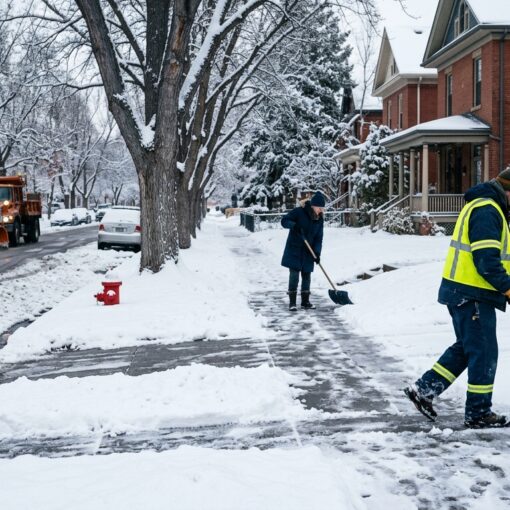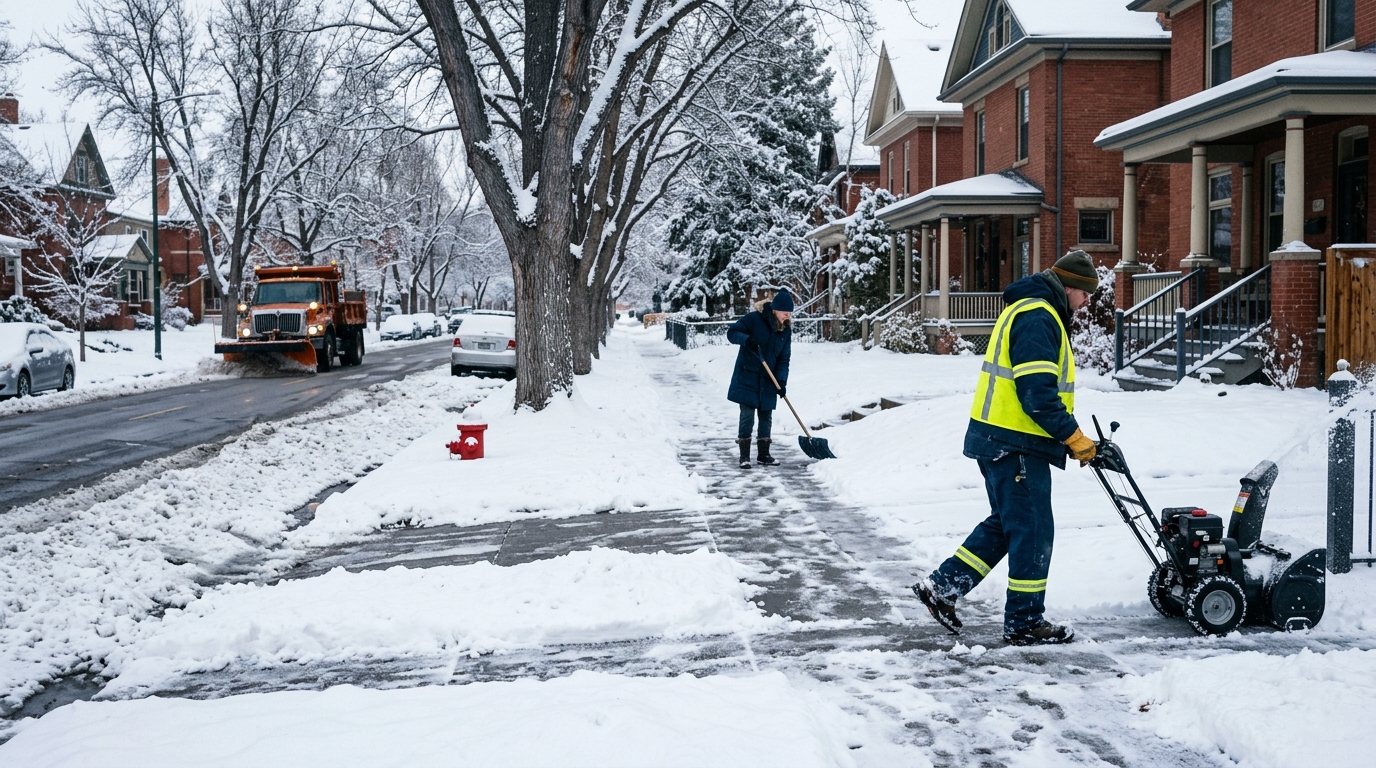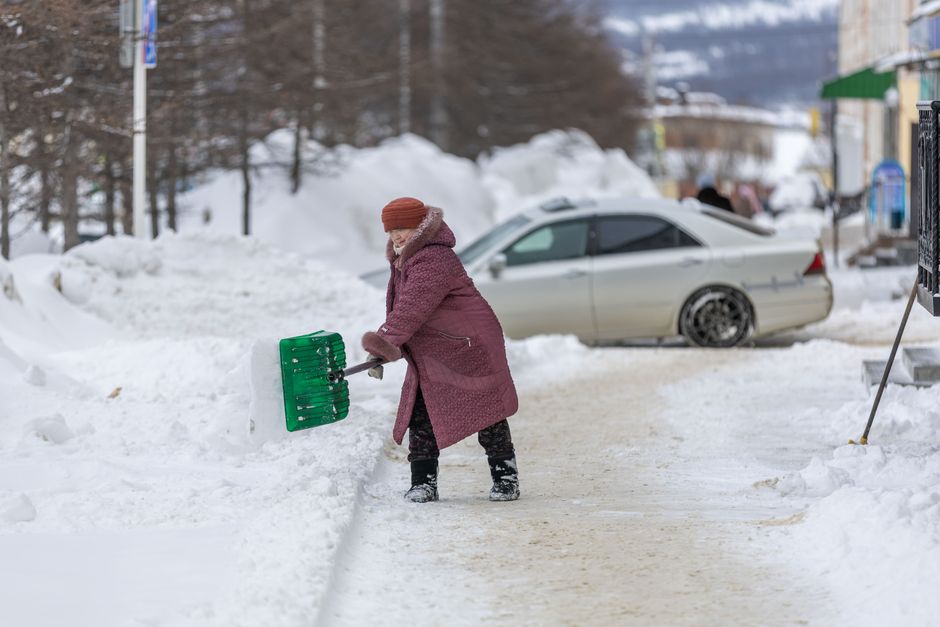
Snow stops falling on a Tuesday night in Wash Park. By Wednesday evening, someone walking to the bus has to step into the street because the walk in front of a building is still buried under a foot of old snow. In Denver, that is not just a neighborly annoyance. Under Section 49-263 of the Denver Revised Municipal Code, property owners are required to clear the sidewalks next to their property within 24 hours after the snow stops falling. That obligation applies to homeowners, landlords, HOA boards, and commercial property managers throughout the city, and heading into the 2026 winter season the basics have not changed.
What follows is a plain-English breakdown of the rule, which surfaces fall under it, where the gray areas tend to trip people up, and how to stay ahead of it when storms stack up back to back.
What Denver’s sidewalk snow removal law actually requires
Denver puts the duty on the property owner. Not on the city, not on the person who happens to walk the block first, and not on whichever neighbor feels guilty enough to grab a shovel. If your property touches a public sidewalk, the snow and ice on that stretch of walk is your responsibility to deal with.
The requirement covers two separate jobs:
- Removing accumulated snow from the sidewalk surface
- Removing ice, or treating it so the walk is safe to use
Colorado snow ordinances are generally written to protect public safety, and many municipal codes state directly that violating the removal duty can be treated as negligence. That language is the part worth paying attention to. A snow-packed walk is not only an enforcement issue, it is a liability issue the moment someone slips on it.
The 24-hour clock starts when the snow stops falling
The deadline is not “sometime today,” and it is not “once the whole metro is plowed out.” Denver’s rule gives property owners 24 hours after snowfall ends to get the sidewalk clear. For an overnight storm that finishes at 3 a.m., the clock is already running while you are asleep.
Two practical consequences fall out of that timing:
- A walk cleared at hour 26 is late, even if it looks perfectly fine when someone inspects it
- A second storm resets the clock, so a walk that was compliant on Monday can be out of compliance again by Wednesday
Snow clearing laws vary from city to city, so if you own property in more than one Colorado municipality, check each one separately. Englewood, for example, requires snow and ice to be removed from all sidewalks in the city within 24 hours after snow stops falling. Denver’s ordinance language and enforcement practices can be updated from time to time, so anyone who needs the authoritative current version should confirm it with the City and County of Denver.
Who is responsible when the property is a rental
For rental property, the ordinance duty sits with the property owner. That does not automatically mean the owner is the one holding the shovel. Landlords and property managers may be allowed to include snow removal requirements in a lease agreement that shifts day-to-day responsibility to the tenant.
If you own a rental, put the answer in writing before the first snow. Decide up front whether the tenant clears the walk, the owner arranges a service, or the HOA covers common areas. Vague expectations are how a quiet December misunderstanding turns into a February liability claim.

Where the snow is allowed to go
Shoveling the walk is only half the job. Where the snow ends up matters just as much. Pushing it off the sidewalk and into the roadway creates a hazard for drivers and can undo the work plows already did on the street. Neighboring cities such as Englewood explicitly prohibit pushing snow into the street, and the same common-sense principle applies in Denver.
Safe places to pile snow include landscaped areas, lawns, and other parts of your own property that will not interfere with traffic, drainage, or a neighbor’s access. The bad options are the ones that get someone hurt or get you cited: the street, a bus stop pad, a crosswalk, or the accessible ramp at the corner.
Which surfaces count as yours
The core obligation is the sidewalk adjacent to your property. How much sidewalk that actually is depends on the lot.
- Interior lots typically have one frontage along the public walk
- Corner lots usually have two frontages, which doubles the linear feet to clear
- Properties along arterial streets may have longer stretches than they expect
Corner ramps, curb cuts, and pedestrian connections between the sidewalk and the street are the edge cases that cause the most argument. The safe play is to clear them along with your walk where they sit on your frontage, and to confirm anything ambiguous with the City and County of Denver rather than assuming the adjacent business or the parks crew will handle it.
HOAs and commercial properties
HOA boards and commercial property managers deal with a wider surface area than a single homeowner. That typically includes common sidewalks, shared walkways, building entrances, stairs, and parking lots. Those are the same paths residents, tenants, and customers use first thing in the morning, which is why commercial and HOA clearing often needs to happen well before the standard 24-hour window closes. Getting walkways and entrances open before the morning commute is a service standard, not a legal requirement, but it is the one that prevents claims.

Liability: the ordinance duty and the common law backdrop
Colorado’s Supreme Court has held that property owners have no common law duty to remove snow and ice that accumulates naturally on a public sidewalk. That ruling surprises a lot of people, and it is worth understanding what it does and does not mean.
It does not mean there is no duty. It means the duty comes from the ordinance rather than from judge-made law. Denver’s code creates an affirmative obligation to remove snow and ice from sidewalks, and violating that obligation can be treated as negligence. In other words, the ordinance is the thing that creates the exposure. A property owner who ignores the walk is not protected by the common law rule, because the code supplies the duty the common law does not.
Enforcement and the cost of waiting
Denver handles sidewalk snow complaints through code enforcement, and the practical trigger is usually a report from a neighbor, a pedestrian, or someone who took a fall. Penalty schedules and enforcement priorities can change, so the exact current fine amounts are something to verify with the City and County of Denver rather than assume from an old blog post.
The financial side of this is not really the point, though. A citation is a one-time hit. A slip-and-fall claim, an insurance rate increase, and a season of angry neighbors are the costs that persist. Treating the 24-hour window as a hard deadline rather than a suggestion is the cheapest risk management available to a Denver property owner.
DIY versus hiring a Denver County crew
Plenty of homeowners clear their own walks and do it well. The calculation changes when a storm dumps heavy snow overnight, when the property has two frontages, or when nobody is home during the day. That is usually where people start pricing out help.
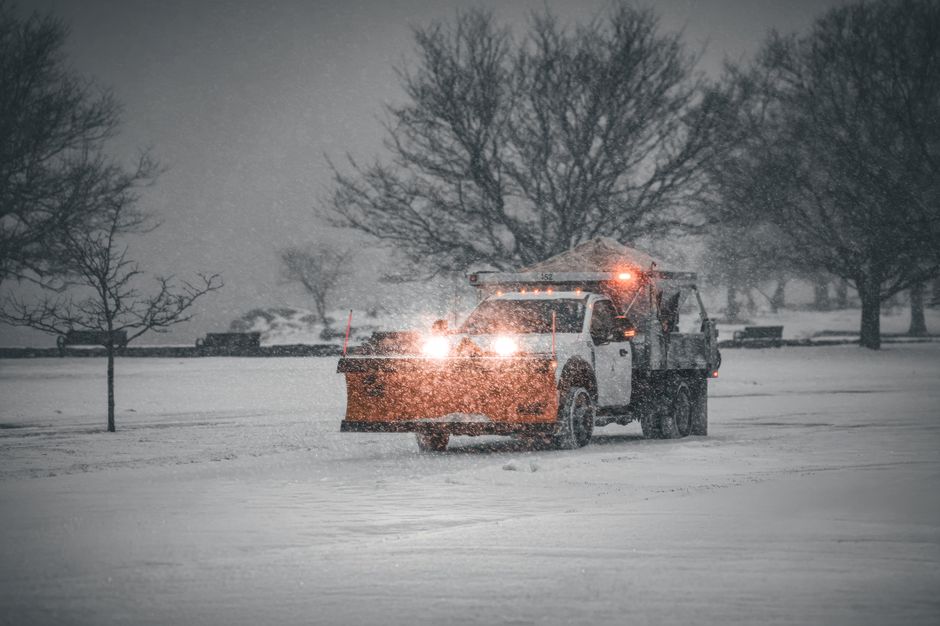
For reference, local per-push pricing for residential and commercial snow clearing in Denver County runs roughly $35 to $85 depending on the size of the property and the scope of work. Seasonal contracts are also common for HOAs and commercial sites that want a fixed number instead of a per-storm bill. MileHiSnow, which operates denversnow.com, has been family-owned since 1974 and runs 24/7 snow removal, de-icing, and ice melt service with GPS-tracked, timestamped logs and before-and-after photo proof on every visit. If you want ice melt that is easier on pets and landscaping, ask for a pet-friendly, non-corrosive product such as Ice Slicer.
One detail that matters more than most people realize: the service area. Crews that route only inside Denver County on surface streets move faster during a storm than outfits that travel highways between suburbs. Denver County-only coverage typically includes Glendale, Edgewater, Englewood, East Lakewood, and West Aurora within about 10 miles of downtown Denver. Properties in Brighton, Centennial, Parker, Castle Rock, Longmont, or Commerce City north of the metro are generally outside that footprint, since reaching them means highway travel during blizzard conditions.

A simple storm-day routine that keeps you compliant
Most violations are not caused by people who refuse to shovel. They are caused by people who lose track of time or underestimate how fast snow sets up into ice. A short routine solves most of it.
- Note when the snow actually stops, because that is when your 24 hours begin
- Shovel once during the storm if the accumulation is heavy, then again after it ends
- Clear the full width of the walk, not a narrow single-file path
- Chip or treat ice rather than leaving a polished glaze under a thin layer of snow
- Keep the corner ramp and curb cut clear if they sit on your frontage
- Re-check after plows pass, since they can push snow back onto the walk
- Take a quick photo after you finish, which is useful if a complaint ever comes in
Frequently Asked Questions
How long do Denver property owners have to clear a sidewalk?
Under Section 49-263 of the Denver Revised Municipal Code, property owners must clear the sidewalks adjacent to their property within 24 hours after snowfall ends. The clock starts when the snow stops falling, not when you wake up or when the storm clears the entire metro. If you need the current official wording, confirm it directly with the City and County of Denver.
Can I be fined for not shoveling my sidewalk in Denver?
Yes, Denver enforces sidewalk snow removal through code enforcement, and complaints are often what trigger a visit. Penalty schedules can change over time, so the exact current fine amounts are worth verifying with the City and County of Denver rather than relying on an old article. The bigger financial risk is usually a slip-and-fall claim, not the citation itself.
Is it illegal to shovel snow into the street?
Pushing snow into the roadway is prohibited in neighboring cities such as Englewood, and it is a bad idea anywhere in the metro. It creates a hazard for drivers and can undo plow work on the street. Pile snow on your own lawn or landscaping instead, away from crosswalks, bus pads, and corner ramps.
Does the tenant or the landlord have to clear the sidewalk?
The ordinance duty sits with the property owner. However, landlords and property managers may be allowed to include snow removal requirements in a lease agreement that makes the tenant responsible for the day-to-day clearing. Put the answer in writing before winter so nobody is guessing during a storm.
Does the 24-hour rule apply to corner lots too?
It does, and corner lots usually have two sidewalk frontages instead of one, which doubles the linear feet to clear. Corner ramps and curb cuts are the ambiguous spots that cause the most disagreement. Clear them along with your walk where they fall on your frontage, and check with the City and County of Denver on anything unclear.