What Your Condo Association Is Responsible For in Denver Snow
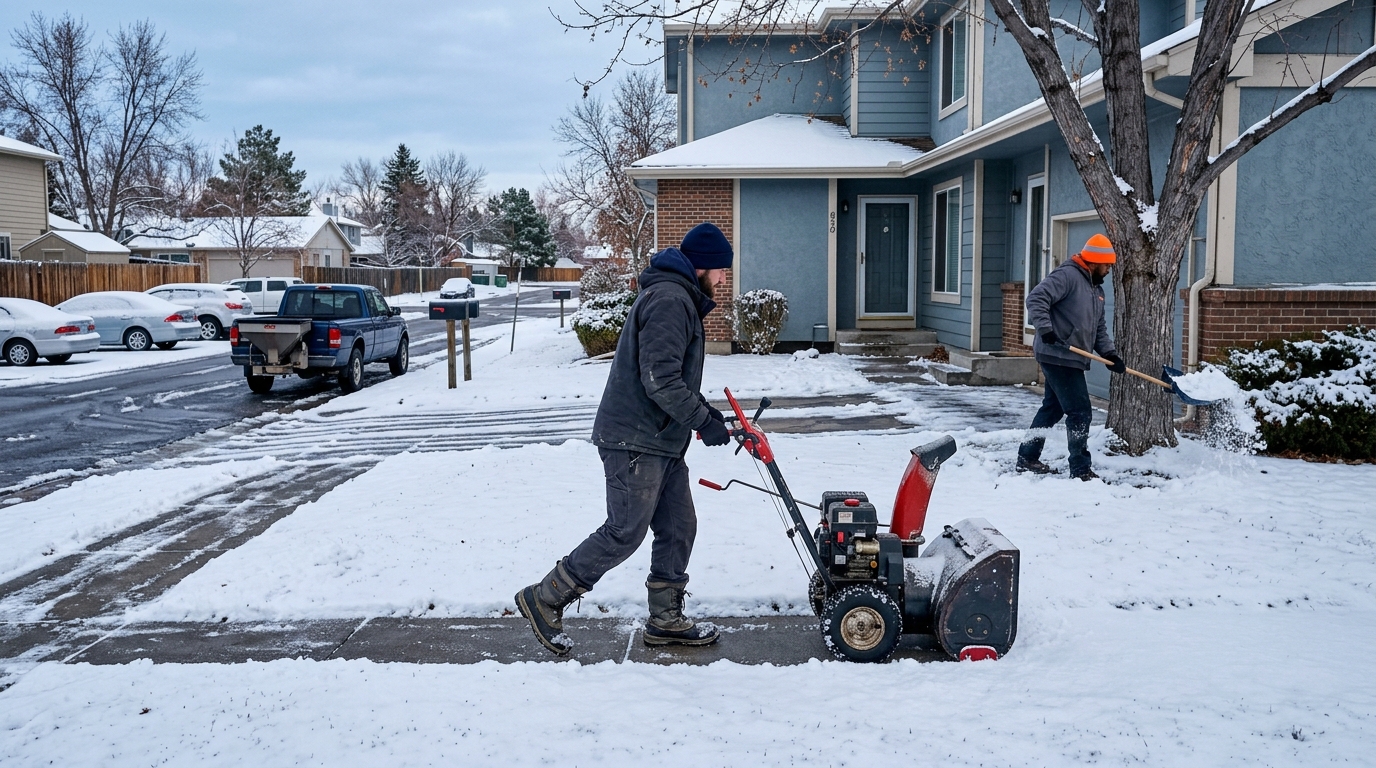
The first thing most board members want to know is what the association is actually on the hook for. The short answer: HOAs are responsible for snow removal when the area falls within communal amenities, or when the association’s own policies say they are, as FirstService Residential puts it. In a condo community, that usually covers shared parking lots, access drives, common walkways, building entrances and stairs, and sometimes the private driveways serving individual garages. Denver condo fee guides list snow removal as a standard line item and tell buyers to confirm whether sidewalks and driveways are included in the dues. That advice tells you owners often assume more is covered than the documents say.
Just as important is what the city does not do. Denver’s street program covers roughly 2,050 lane miles of main streets, according to the City and County of Denver. Your association’s lots, drives and internal walks fall outside that program. Clearing them is a private job, and the community has to fund and manage it.
Sidewalks along public streets add another layer. Reporting from Denver7 describes a system where inspectors leave time-stamped notices, after which businesses have 4 hours and residences 24 hours before a $150 fine. The city also urges residents to report unshoveled walks to 311 a day after snowfall. Those details are dated, and outlets describe them differently, so don’t hard-code any deadline into your contract or owner communications. Confirm current requirements with Denver 311 or the Department of Transportation and Infrastructure, then set your response standard to beat the strictest version.
We haven’t researched Denver-specific condo bylaw or governance rules, so read your own declaration and rules before assuming who owns what. Those documents, not a general guide, decide where the association’s duty ends and the owner’s begins.
How Colorado’s 2018 Snow Liability Law Changes Your Contract
Any board shopping for condo association snow removal in Denver should understand the Snow Removal Liability Limitation Act, which took effect August 8, 2018. According to Goodman and Wallace, the law voids hold-harmless and indemnification language in snow and ice control contracts where the provider is prohibited from mitigating a specific snow, ice or mixed-precipitation event. Put plainly, a contract can’t say the vendor won’t plow until three inches fall and also make the association promise to cover the vendor’s liability when someone slips on two inches.
The practical effect cuts against the association. Because the provider can’t be required to indemnify you for liability arising from snow and ice removal, your community may carry more exposure than older contracts assumed. The same firm notes the Act doesn’t rule out breach of contract or general negligence claims when a provider fails to deliver the services it promised. So the contract still matters a great deal. What the vendor agreed to do, and whether it did it, remains the foundation of any dispute.
This is worth spelling out because some vendor material still pushes blanket indemnification as a non-negotiable term. That advice sits uneasily with the statute for trigger-limited contracts. Don’t accept or insist on indemnification language without asking your association’s attorney how it interacts with the Act. A Colorado HOA law firm’s commentary, New Law Prompts Snow Removal Contract Review, is a good starting point for that conversation.
What should you put in place of leaning on indemnity? Documentation and clear performance language. A vendor who logs arrival times and records photo proof of each visit hands the board evidence of what was actually done, and that is your best protection when a claim comes in. Records like these support a breach-of-contract position if service falls short, and they show owners the money is being spent as promised. For a deeper look at screening vendors before storm season, see vetting a Denver residential snow removal service before the first storm.
Writing Scope: Common Areas, Driveways and Unit Walkways
Scope is where most owner complaints start, and it’s the part published guidance covers least. Nothing we found shows how a condo board should split responsibility between common areas, private driveways and unit walkways. Treat what follows as a framework to adapt to your own documents, not a rule.
Start by sorting every surface the association touches into three buckets. The first is shared common area: main parking lots, drive aisles, guest parking, mail kiosks, building entrances, shared stairs and the main pedestrian routes. These are almost always association duties. The second is semi-private space: individual driveways and garage aprons that the community plows for convenience even though a single owner uses them. The third is unit-specific walkways and patios. Many declarations leave these to owners, though some associations take them on for a fee or as a standard service.
For each bucket, write down who clears it, to what standard, and by when. A good scope description names the surface, the method (plow, shovel, blow, de-ice) and the expected clear width, such as a continuous walking path to each entrance. Include accessible routes, ramps and any bus-stop or curb areas you maintain, since those are where complaints turn serious. Also specify where snow gets stacked. Denver prohibits pushing snow into public streets and other rights-of-way, so the contract should require the crew to pile snow on-site in designated areas that don’t block drains, mailboxes, fire access or parking you need.
Then communicate it. Put the scope in plain language in a one-page owner notice: what the association clears, what owners must clear themselves, and what happens in a heavy storm. When residents know the plowed driveway is a courtesy with limits, and that the crew will come back after the storm ends, you get fewer angry emails. If your community mixes homes and condo buildings, our guide to snow removal services in Denver for homes, HOAs and commercial properties shows how scope differs by property type.
Choosing a Trigger Depth and Contract Terms
Trigger depth, the snowfall at which crews are authorized to start work, is the biggest lever on both cost and service. A lower trigger means the vendor mobilizes more often and you pay for more visits. A higher trigger, such as three inches, costs less but comes with a catch described in the HOA law commentary: crews tackle one- and two-inch trigger properties first, so a three-inch association falls farther down the priority line in a heavy snowfall. You aren’t only saving money. You’re accepting a longer wait when it snows hard.
That tradeoff has to be weighed against owner expectations and liability. A trigger so high that ice-prone, shaded walkways go untreated invites falls and claims, and the 2018 Act specifically targets contracts that bar the provider from mitigating a given event. Many boards settle on a modest trigger for pedestrian areas and entrances while allowing a higher one for large parking fields, or add a separate rule that treats ice on walks regardless of depth.
Beyond depth, a contract worth signing covers several terms:
- Response standard: How many hours after the storm ends will each area be cleared, and what happens when the standard is missed?
- Back-to-back storms: Are repeat visits included, and is there a seasonal cap that could leave you with a surprise bill?
- Documentation: GPS-tracked arrival times and photo proof of every visit, delivered to the manager or board.
- Insurance: A certificate showing the vendor’s coverage, naming the association where appropriate.
- Crew status: Whether the work is done by the vendor’s own employees or subcontracted, since that affects accountability.
- Exit rights: Clear termination and performance clauses so the board can leave if the vendor keeps missing the standard.
Don’t let a contract stay silent on ice control, re-treatment after melt-and-refreeze, or who clears snow piles that block sight lines. Those gaps are where disputes live. For a checklist of warning signs in vendor proposals, read snow removal service Denver red flags that slow down your clearing, and for a comparison approach see how to compare crews in 2026.
What Drives Snow Removal Cost and How to Budget for It
No published price exists for large condo associations, and the figures that do circulate cover small associations only, so we won’t quote a number. Explain the pricing drivers to your board instead, and use real bids to set the budget.
The first driver is surface area: the square footage of lots and the linear feet of walks to be cleared and treated. A sprawling community with long drive aisles costs more than a compact one. Second is trigger depth, covered above, which controls how many times the crew mobilizes in a season. Third is the structure of the contract: per-visit, per-event or a seasonal flat rate. Per-visit pricing is cheaper in a light winter and painful in a heavy one. A seasonal contract smooths the budget but may carry caps or exclusions you need to read carefully. Fourth is service level. Shoveling versus plowing only, deicing, hauling snow off-site and response-time guarantees all change the price. Finally, access and layout matter. Tight lots, cars left in the way and limited stacking space slow crews and raise cost.
To budget sensibly, collect at least three written bids based on the same scope document, so you’re comparing like with like. Ask each bidder to price light, average and heavy winters, and to disclose any seasonal cap. Build a reserve line into the budget for an unusually snowy year rather than relying on a special assessment after the fact. Fees are a normal part of condo dues, and a clear, documented snow line item is easier to defend than one that jumps every February.
Finally, remember that Denver County-only crews can often reach you faster than metro-wide operators stretched across many suburbs; see why a county-only crew can beat a metro-wide one. If you manage a larger community, snow removal for apartment complex Denver is a useful companion read. With a written scope, a deliberate trigger depth and documented service, your condo association snow removal Denver contract becomes something the board can defend to owners in any winter.