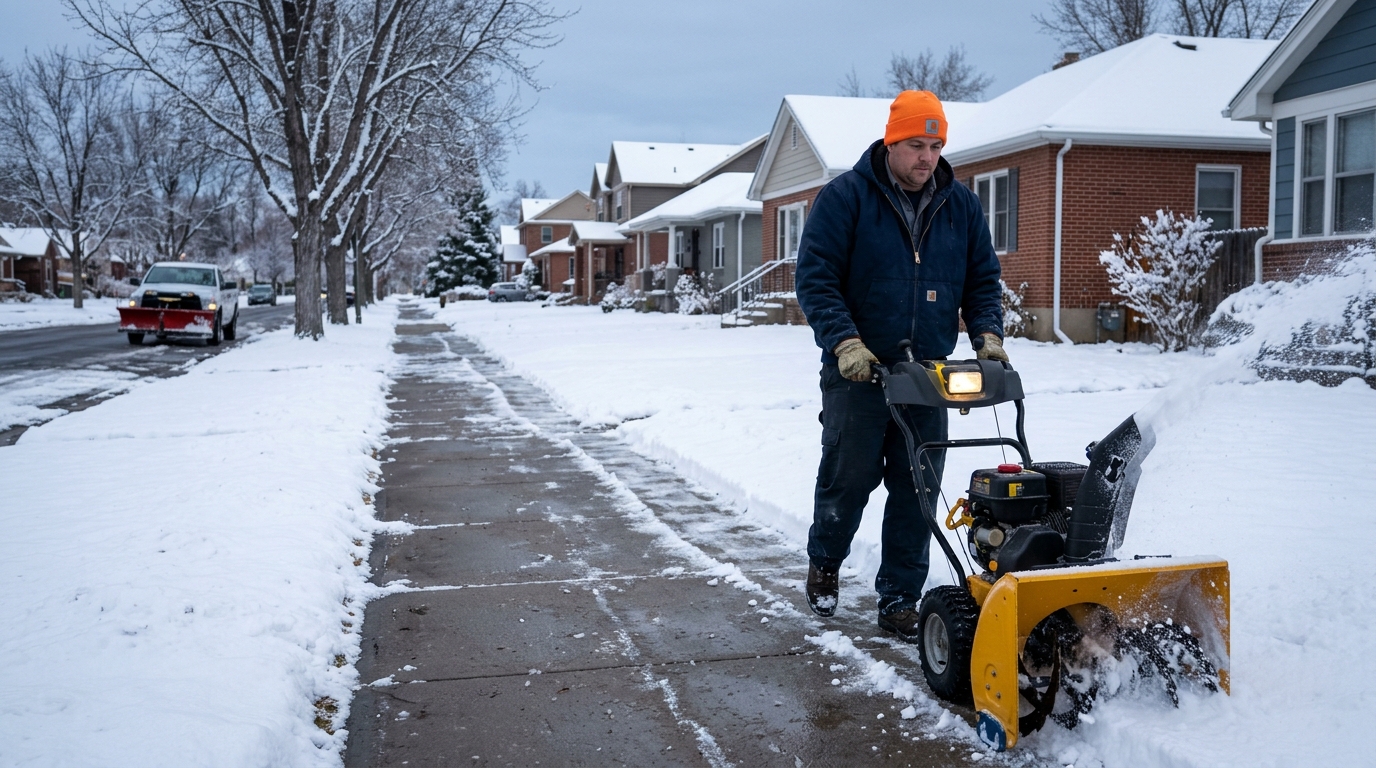
Short Answer: Owners Clear Denver Sidewalks, Not the City
No. The City of Denver does not shovel the sidewalk in front of your house, your rental, your HOA’s common walk or your storefront. Under city rules, property owners (and, per the city’s own fact sheet, tenants) have to clear snow and ice from the sidewalks next to their property. The City and County of Denver’s snow removal page states that Denver requires property owners to clear their sidewalks, including adjacent ADA ramps and bus stops.
That catches plenty of people off guard, because the city does plow streets and does clear some public walkways. But plowing a street and clearing the sidewalk beside it are two different jobs, and only the street belongs to the city. So when people ask whether the city of Denver is responsible for sidewalks, the practical answer is that the city enforces the rule and you meet it.
The same answer holds whether you own a single-family home, manage a 40-unit rental building, sit on an HOA board or run a business. If a walkway touches your property line, assume the clearing is yours. Tenants should check the lease, since many landlords pass the duty to renters in writing. Either way, the city looks at the property, not the lease, when it inspects.
If you’d rather hand the work off than do it yourself, that’s what a full-service residential snow removal crew is for. Just remember that hiring someone moves the labor, not the legal responsibility.
Owner Deadlines, Inspector Notices and Reported Fines
The clock starts when the snow stops falling, not when the first flakes land. According to the city, businesses need to start clearing their sidewalks immediately after snow ends, while residences have until the next day. That split matters: a retail strip or restaurant gets essentially no grace period, and a house gets roughly one night.
Enforcement runs on notices. Per 9NEWS, inspectors leave a time-stamped notice at properties with unshoveled walks. After that notice, businesses reportedly have four hours and residences 24 hours before the inspector comes back to re-check, and a $150 fine may follow. Treat that figure as reported rather than guaranteed. News coverage ages quickly, and the amount or process may have changed, so confirm current numbers with the city before you rely on them.
Neighbors can set the process in motion too. If it’s been more than 24 hours after a storm and a nearby sidewalk is still buried, residents are directed to call Denver 311. The inspectors who respond work through the city’s Community Planning and Development department, according to reporting from Collective Colorado.
A few practical points follow from this:
- A notice is a warning with a short fuse, not a formality. Clear the walk the same day you find it.
- Clearing means a usable, safe path, not a single shovel-width trench that refreezes into ice overnight.
- The city encourages pre-treating walks and ramps before a forecast storm. De-icer down ahead of time makes snow and ice far easier to remove afterward.
For a plain-language summary of how the rule reads from an owner’s side, our guide to the Denver sidewalk snow removal law and 2026 rules for property owners goes into more detail.
Corner Lots, ADA Ramps, Bus Stops and Plow Berms
This is where most of the confusion and most of the complaints come from, because the "sidewalk" on a corner is really several pieces of pavement.
If you own or manage a corner property, your duty typically covers more than the straight stretch of walk. Per Collective Colorado, owners are responsible for adjacent mobility ramps and for curb cuts when the residence or business sits on the corner of a block. Those ramps aren’t decoration. For a wheelchair user, a person with a walker or a parent with a stroller, a ramp packed with plow slush can make the whole corner impassable, even if the rest of the walk is perfectly clear. Clear the ramp all the way to the street, and keep the gutter edge open so meltwater has somewhere to go instead of pooling into a sheet of ice.
Bus stops follow similar logic. Owners are responsible for adjacent bus stops that RTD does not own. RTD handles its own shelters, but a bench-and-sign stop in front of your building is generally yours to keep clear. If you manage an apartment community or a commercial property along a transit line, put the stop on your storm checklist.
Then there’s the plow berm. The city openly acknowledges that plowing a street pushes snow onto sidewalks and driveways, calling it an unfortunate consequence of the job. Here’s the part owners dislike: the plow’s mess doesn’t erase your duty. You still have to clear the sidewalk afterward, including the heavy, icy ridge left at the end of a driveway or across a ramp. Plan on that berm being the hardest, densest snow you move all winter.
One more caution on where the snow goes. Several secondary sources say you shouldn’t push snow into streets, alleys or other public right-of-way. I couldn’t verify the ordinance wording, so check the city’s guidance before you shovel a pile into the roadway. Stack it on your own property, away from ramps and storm drains, where it won’t refreeze across a walkway.
Crews that handle this daily know these details. If your property sits on a corner or a bus line, ask any contractor how they treat ramps and berms specifically. Our notes on snow removal in Capitol Hill and snow removal in Cherry Creek cover how dense, corner-heavy blocks tend to play out.
What the City Does Clear, and Where to Report a Problem
The city isn’t idle in a storm; it just works on different pavement than your front walk. DOTI plows the main streets, and during major events it can send residential plows down the center of side streets in a single pass. Those residential plows shave off the top of the snowpack to prevent deep ice rutting. They don’t expose bare pavement and, per the city’s reporting to 9NEWS, they don’t carry de-icer. You can see where trucks have been on the city’s tracker, which helps explain why your block still looks rough. Our page on the Denver snowplow map live covers what the tracker does and doesn’t show, including its built-in delay.
On the sidewalk side, the city’s own crews cover a narrow slice. Denver Parks & Recreation clears snow on park property and select sidewalks such as bridges and underpasses. That’s the extent of what the city’s official page describes. Residential sidewalks, commercial frontage and private walkways aren’t on the list.
If you hit a problem, the route depends on what kind it is:
- A neighbor’s or business’s unshoveled walk: wait until more than 24 hours after the storm has ended, then contact Denver 311. The residential rule timing is what sets the baseline.
- A street that hasn’t been plowed: 311 can’t take special plowing requests, but the city says it can accommodate ice blading and sanding requests.
- A parking question during a storm: see our overview of the Denver snow emergency parking ban, since street parking rules are separate from sidewalk duties.
Keep your expectations realistic. 311 is a report line, not a dispatch service for shovelers. A report starts the inspector process described earlier; it doesn’t send anyone to clear your neighbor’s walk that afternoon.
Help for Residents Who Cannot Shovel, and Liability Basics
The rule applies equally to the 80-year-old owner with a bad hip and the 30-year-old with a snowblower, which is exactly why it lands hard on older adults and people with disabilities. Collective Colorado’s reporting makes the broader point that unshoveled sidewalks and ramps can be dangerous and often impossible for people with disabilities to navigate, so a neglected walk isn’t just a fine risk, it’s a barrier for someone else.
If you can’t shovel, you have a few realistic options. Ask family, a neighbor or a community group to take the job, hire a service, or set up a seasonal arrangement so you’re not scrambling after a surprise storm. Denver7’s rundown of sidewalk rules and where to get help is a good starting point for volunteer and assistance resources, though availability changes, so confirm before you count on any program. If you want a reliable, documented option, a GPS-tracked snow plow company in Denver that provides photo proof of each visit gives you a record that the walk was cleared and when, which is useful if a notice or a complaint ever lands.
On liability, be careful not to over-read what you find online. Injury lawyers note that slip-and-fall responsibility isn’t automatically assigned to the homeowner just because a walk was icy. Compliance with the local clearing timeframe is one factor courts weigh, according to Bell Pollock, a law firm, so treat that as a commercial viewpoint rather than a legal ruling. One firm also claims Denver can clear a walk and bill the owner for the cost. I couldn’t confirm that on any city page, so don’t plan around it either way.
For landlords, HOA boards and property managers, the safe takeaway is straightforward: your own common-area walks carry the same expectation as any other property, even though HOA-specific rules weren’t verified here. Put the duty in writing, assign it to a named crew, and keep records. If you manage multiple units, our guides on snow removal for apartment complexes in Denver and condo association snow removal in Denver cover how to structure scope and contracts so the sidewalks, ramps and bus stops are all named.
The bottom line on whether the city is responsible for sidewalks: it isn’t, you are, and the deadline is short. Plan before the storm, not after the notice.