What Licensed and Insured Should Mean for Denver Snow Plowing
"Licensed and insured" should be where your questions start, not where they end. Plenty of companies print a badge on a website. What you want is proof you can hold in your hand before the first storm.
Start with what the city does and doesn’t do. Denver’s Department of Transportation and Infrastructure runs 70 large plows across roughly 2,050 lane miles of main streets, but those plows don’t touch private surfaces. Sidewalks, driveways and parking lots belong entirely to property owners. If someone slips on your walkway, the question of who was hired to clear it, and whether that company was properly covered, lands on your desk.
In practical terms, licensed insured snow plowing in Denver should mean three things. First, the contractor holds the business registrations required to operate in the city and can show them. Second, they carry commercial general liability insurance, which covers injury and property damage claims. Third, they carry workers’ compensation, so an injured plow driver or shoveler never becomes your problem. A certificate of insurance should reach you before work begins, not after the first invoice.
Watch the gap between "we have insurance" and "our insurance covers plowing." General coverage can carry exclusions, especially when snow removal is a side business rather than a primary operation. Ask directly whether snow and ice operations are covered, and ask for the certificate instead of a verbal assurance. One insurance source suggests looking for limits of $1 million or more for plowing operations, a reasonable benchmark to discuss with your own insurance advisor.
Crew structure matters here too. Many HOAs hire a vendor, but responsibility still ties back to the property side if tasks don’t get done. When a contractor subs the work out, you’re relying on a second company’s coverage that you may never have seen. A company running its own licensed, insured W-2 crew gives you one certificate, one point of accountability and a cleaner paper trail.
Comparing Denver Snow Contractors: Crew, Records and Response Time
Most contractor pages look alike: a fully insured badge, a 24/7 promise and a phone number. The real differences show up in how a company staffs, documents and responds, so compare on those three points rather than on slogans.
Crew. Ask who actually shows up. Employees on the company’s payroll, trained and covered under workers’ compensation, behave differently from a rotating roster of subcontractors. Ask whether the same crew services your property each storm and who supervises them. For a landlord with several rentals or a board overseeing a community, consistency means fewer surprises.
Records. This is the most overlooked criterion, and the one that protects you most. Snow contracts should use timestamped service logs to prove when the crew was on site. If a claim is filed, your defense depends less on memory and more on whether service times, treatments and weather conditions were clearly documented. GPS-tracked trucks and photo proof of every visit turn a he-said, she-said dispute into a factual record. A contractor who can’t show you a sample log or photo report is asking you to take their word for it. For a closer look at how tracking works in practice, see our page on a GPS tracked snow plow company in Denver.
Response time. Liability often hinges on response time rather than quality of work. If your contract says two hours and someone gets hurt at hour three, the quality of the plowing doesn’t matter. That makes a written, specific response window one of the most important lines in any agreement. Vague language like "as soon as possible" protects the contractor, not you. Look for a defined core response window, a stated process for emergency calls and clarity on what triggers a visit, such as an inch of accumulation versus the end of a storm.
A few supporting details separate serious operators from casual ones. Does the company handle plowing, shoveling and de-icing together, so one crew clears the lot, the walks and the ice? Splitting those jobs across vendors multiplies your coordination burden. If your worry is ice rather than accumulation, our guide on when de-icing beats another snow push explains how the two services differ.
Treat any price you see online with caution. One contractor blog cites a range of $300 to $800 per push for commercial plowing in Denver, but that figure is self-reported and unverified. Pricing depends on lot size, access and service level, so get written quotes for the same scope from each company you consider.
Denver Sidewalk Rules, Notices and Who Is Responsible
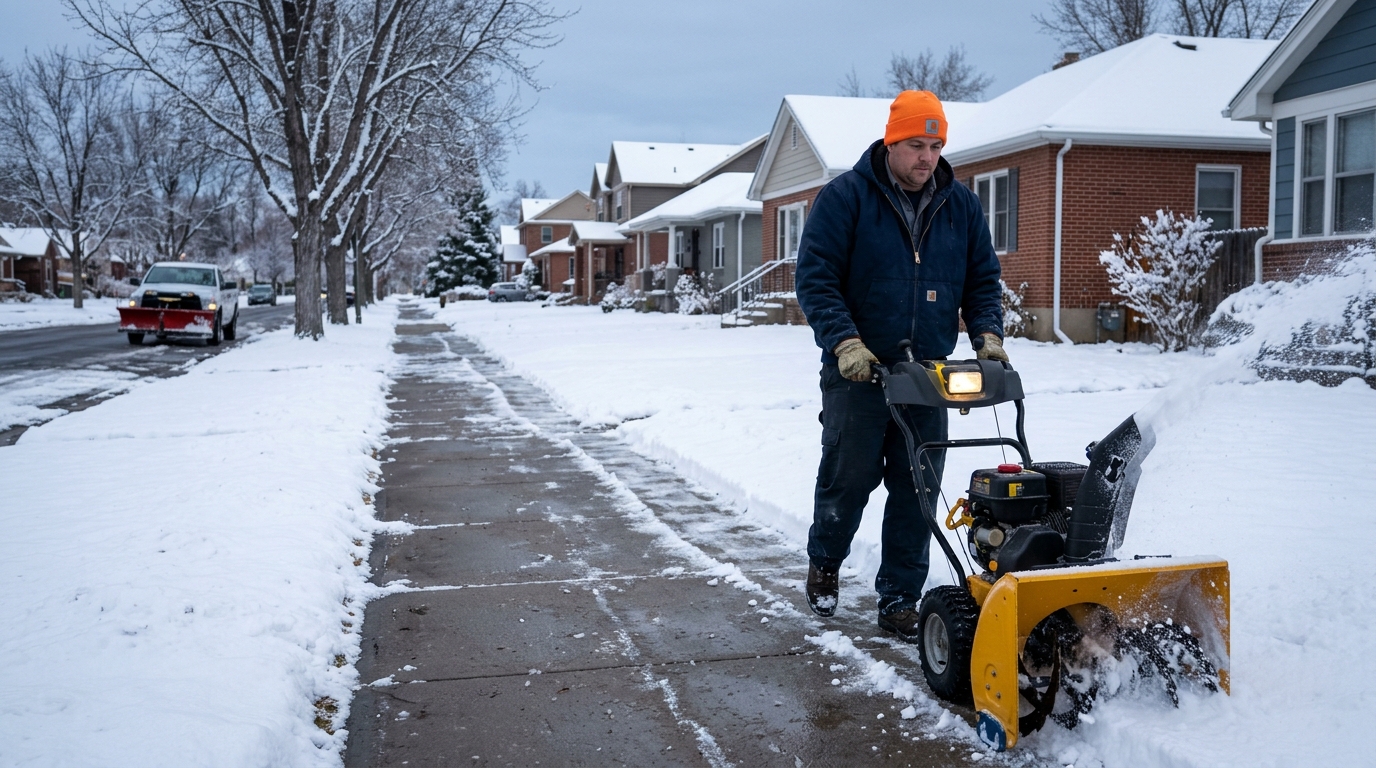
Contractors plow lots, but the sidewalk rules are what put owners on the hook. Denver property owners must clear snow and ice from the sidewalks adjacent to their property, including adjacent ADA ramps. The duty belongs to the owner or occupant, whether or not a vendor was hired.
Reports on the exact deadlines conflict, so rely on the enforcement process rather than any single number you read online. According to 9NEWS coverage of Denver’s shoveling rules, businesses need to begin clearing their sidewalks immediately, while residences need to clear theirs by the next day. Enforcement, as described by KDVR, works through notices: inspectors leave a time-stamped notice at properties with un-shoveled sidewalks. After receiving a notice, businesses have four hours and residences have 24 hours before a re-check and a potential $150 fine. Because accounts differ, confirm current requirements with the City and County of Denver before you write any deadline into a contract.
Two more points trip people up. Snow may not be pushed into public streets, alleys or rights-of-way, so relocating the problem is its own violation. A contractor who clears your lot by shoving the pile into the street has handed you a new exposure. Residents can also report uncleared sidewalks through 311, which means a neighbor, a tenant or a passerby can trigger an inspection.
The human side of this deserves a mention. Reporting from the Colorado Trust describes how snow-covered sidewalks and ramps can be dangerous and often impossible for Coloradans with disabilities to navigate. Clear ramps and curb cuts are part of the job, and a good contractor treats them that way.
If you’re a landlord, check how your lease allocates sidewalk duty, but understand that the ordinance doesn’t disappear because a tenant was assigned the task. For rental-specific guidance, see our piece on residential snow removal for Denver landlords and rentals. For apartment buildings, snow removal for apartment complexes in Denver covers how scope changes at scale.
Contract Terms for HOAs, Landlords and Property Managers
A solid contract turns a contractor’s marketing promises into obligations. Whether you manage a community, a handful of rentals or a small commercial lot, the same clauses deserve your attention.
Insurance and additional-insured status. The contract should require the contractor to keep general liability and workers’ compensation in force for the full season and to deliver a certificate of insurance before work begins. Ask to be named as an additional insured where appropriate, and have your own insurance advisor confirm the wording. Request a fresh certificate if a policy renews mid-season.
Scope. Spell out exactly what’s covered: driveways, drive aisles, parking stalls, sidewalks, ADA ramps, building entrances and any stairs. Specify whether shoveling and de-icing are included or billed separately. Our overview of what full-service residential clearing covers is a useful reference for building that list.
Triggers and response. Define the snowfall depth that triggers service, the maximum time between trigger and arrival, and what happens during prolonged storms that need repeat visits. Write down the response window, since timing is where liability often turns.
Documentation. Require timestamped service logs and photo proof of each visit, delivered in a form you can retrieve later. This protects you in a claim and gives a board or owner something concrete to review when residents complain.
Snow placement. Include a clause forbidding snow from being pushed into public streets, alleys or rights-of-way, and designate where piles may go on the property so they don’t block sightlines or drainage.
Subcontracting. State whether the contractor may subcontract, and if so, require the same insurance evidence from the sub. Many HOAs hire a vendor, but responsibility still ties back to the property side if tasks do not get done, so you want visibility into who is really on the truck.
Boards and associations. Condo and HOA boards face added complexity around common areas, private streets and resident expectations. Our guide to condo association snow removal in Denver walks through scope and contract structure for those situations.
How to Choose and Verify a Denver Snow Plowing Contractor
Choosing well comes down to verifying a short list of things before the season starts, not during a storm when you have no leverage.
Work through these criteria in order:
- Ask for the certificate of insurance and read it. Confirm general liability and workers’ compensation, check the policy dates, and ask whether snow and ice operations are covered. Don’t accept a verbal assurance or a website badge.
- Confirm the crew model. Ask whether the people on your property are the company’s own employees or subcontractors, and who carries the coverage for them.
- See a sample record. Request an example of a timestamped service log or photo report. If a company can’t produce one, your claim defense will rest on memory.
- Get the response window in writing. A specific number of hours, with a defined emergency process, beats any promise of fast service.
- Compare like for like. Collect written quotes covering identical scope, triggers and response terms, so differences in price reflect real differences in service.
- Check local fit. A contractor that works within Denver County understands the city’s inspection model and neighborhood conditions better than one stretching across a wide territory. Neighborhood-specific pages such as snow removal near Capitol Hill and snow removal in Cherry Creek show how access and parking vary by area.
A few warning signs are worth acting on. Be skeptical of any company that dodges requests for paperwork, quotes a price with no scope attached, or won’t commit to a response time. Watch out for look-alike names too: several Denver companies use similar business names, so confirm the exact legal entity on the certificate matches the company you’re signing with. For more on spotting trouble early, read about red flags that slow down your clearing, and use our pre-storm vetting guide for residential service as a checklist.
Finally, do this before the first forecast, not after it. The best time to verify insurance, review a contract and confirm a response window is a calm week in the fall. When the storm arrives, you want a contractor whose paperwork is already in your file, whose crew is already assigned and whose records will protect you if something goes wrong. That is what licensed insured snow plowing in Denver should actually deliver.