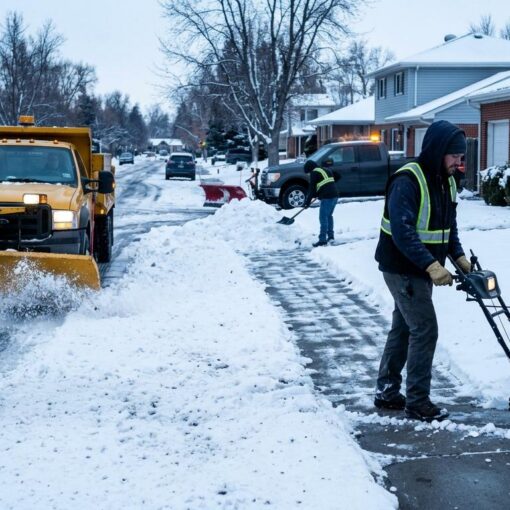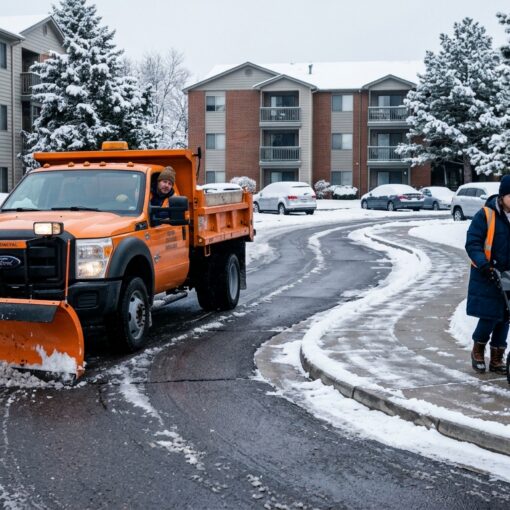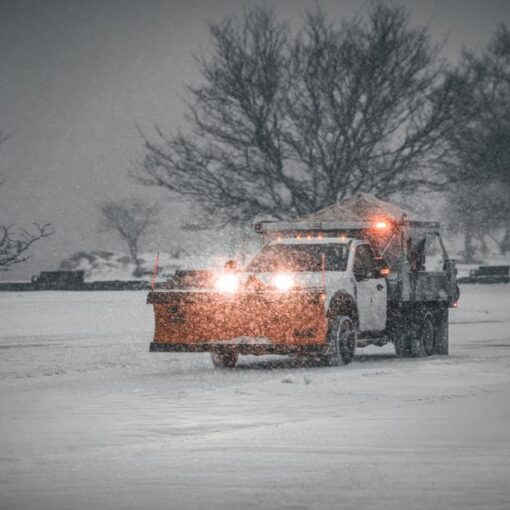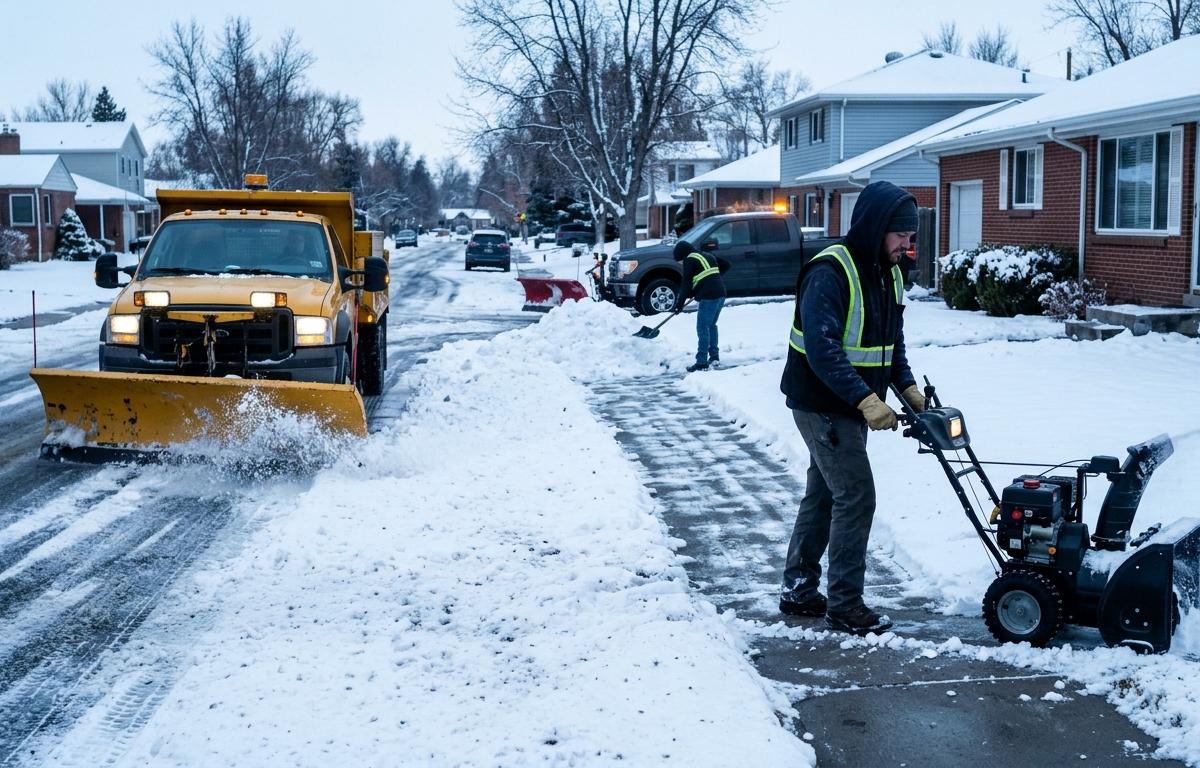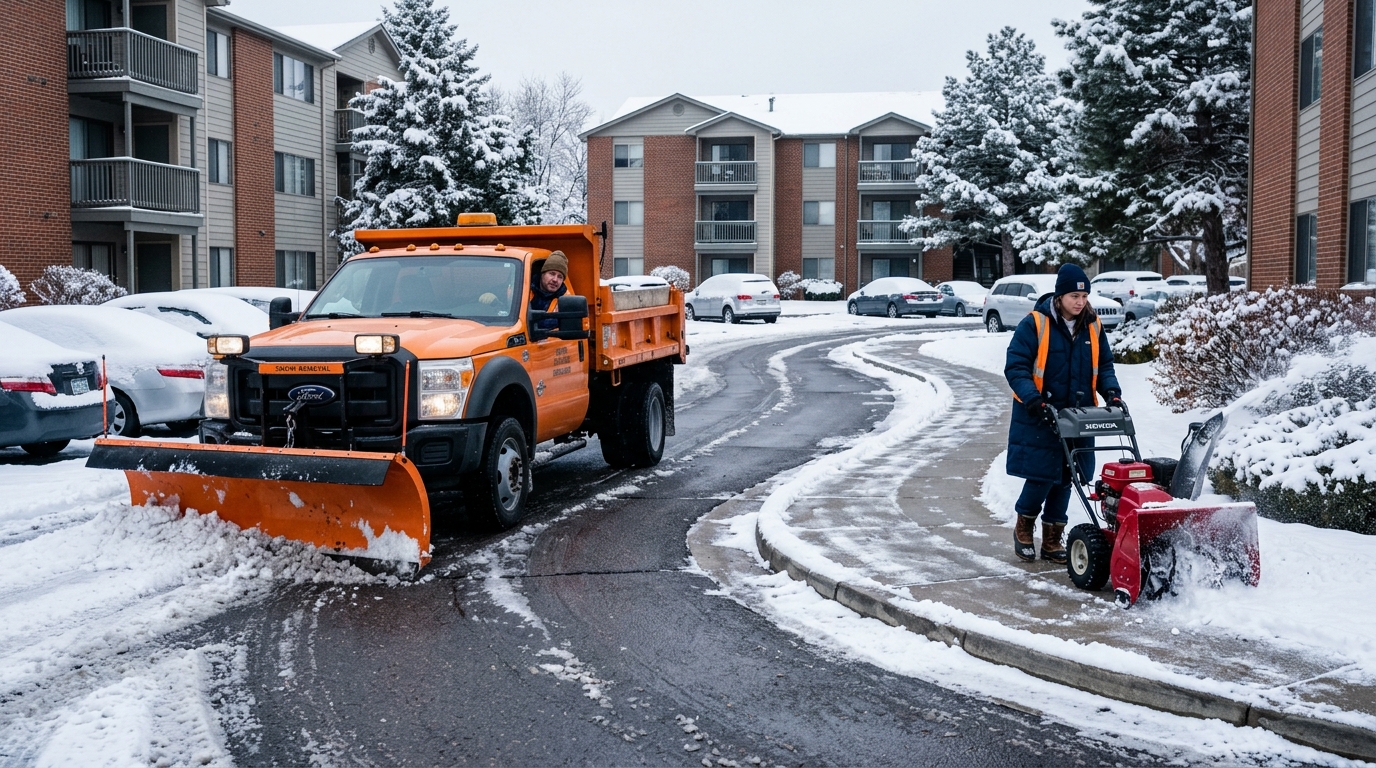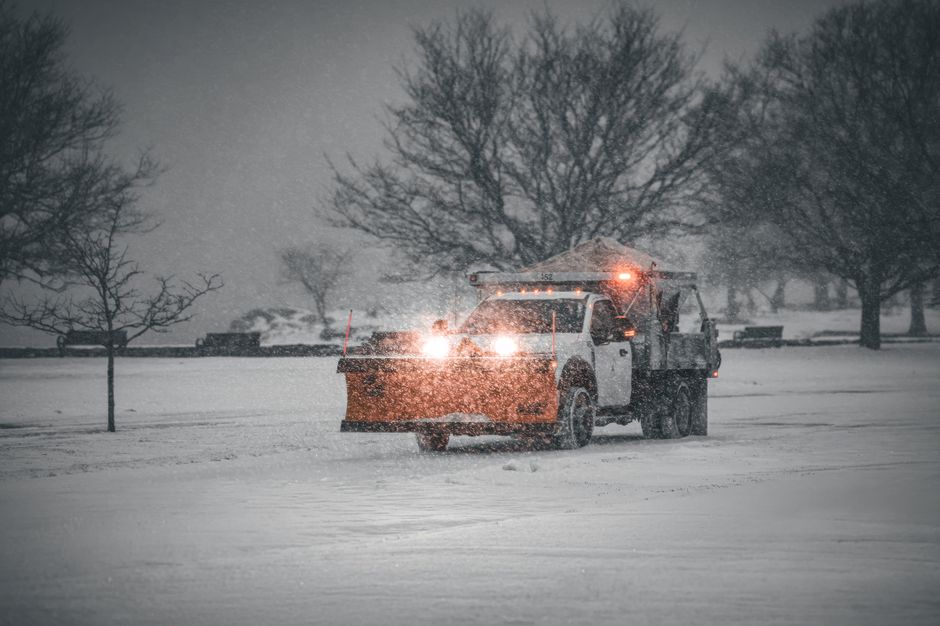
The morning after a major Front Range storm is a stress test for every property inside the city. Driveways are buried, sidewalks have vanished, and parking lots turn into ice rinks. The crews that get there first are almost never the ones driving in from somewhere else. They are the ones who were already parked inside Denver County when the snow started.
That distinction matters more than most homeowners realize. Snow removal in Denver is a routing problem, a timing problem, and a proof problem all at once. When a contractor is based in Denver and only works Denver, all three get easier.
What a Big Storm Does to the Denver Snow Market
Demand spikes the moment a major storm enters the forecast. Phones ring at every company in the metro, and once the local crews are booked solid, property managers start calling whoever answers. That is how long-distance and out-of-state subcontractors end up on Denver routes in the first place.
They are not a bad option on paper. They are simply working against a clock that starts ticking the second the first flakes land, and they are starting that clock somewhere far from your property. Denver Snow Removal at denversnow.com, operated by MileHiSnow, keeps its service area deliberately tight for exactly this reason. The company does not travel to Brighton, Centennial, Parker, Castle Rock, Longmont, or Commerce City north, and it does not run I-25 or I-70 during blizzard storms. A route that never leaves the county keeps moving while the highways do not.
How the City Responds, and Where Private Crews Fit
Emergency snow response in Denver falls within the purview of the Department of Transportation and Infrastructure, known as DOTI. The department describes its workforce as performing snow removal in an efficient, effective and fiscally responsible manner, backed by a proven response plan. City crews work the routes in that plan, and details can change with conditions, so the current version is always worth checking directly at denvergov.org.
What city plowing does not cover is private property. Your driveway, sidewalk, porch, stairs, parking lot, and building entrances belong to the owner or the manager. That is the gap a private snow removal company fills, and it is a wide gap after a storm heavy enough to shut down normal routines for a day or two.
The Routing Advantage of a Denver-Owned Crew
Routing sounds like a back-office detail. In a blizzard, it is the whole game. Here is where a Denver County-only operation separates itself from a crew that treats Colorado as one big map.
No Highway Gambles
Crews reaching Denver from outside the metro depend on I-25 and I-70. Those are the first roads to slow down, back up, or close when a storm rolls through. A Denver-owned crew working inside Denver County never has to make that bet, because the route never includes a highway segment that could strand it for hours.
Surface Street Familiarity
Knowing a neighborhood is not the same as knowing its alleys. Denver blocks have narrow side streets, alley parking, tight corners, and driveways that get buried twice if the plow angle is wrong. A driver who works the same streets all winter learns where snow can be stacked, where cars sit overnight, and which corners ice up first after the temperature drops.
Shorter Distances Between Jobs
When properties are clustered inside the county, a truck finishes one driveway and is at the next in minutes. Long-distance routes spend their hours in transit instead of on the shovel. That gap shows up most on the second and third pass, which is precisely when a big storm tests a schedule.
Why the 2 to 4 Hour Window Holds Up
For a crew to clear a Denver property within a few hours of a storm, several things have to line up. The trucks must already be inside the service area when the snow starts. The route has to be short enough that a driver is not burning an hour just reaching the first job. And the schedule has to be built around Denver streets rather than a metro-wide map stretching from Castle Rock to Longmont.
Denver County-only routing is what keeps a 2 to 4 hour response window realistic. Every mile outside the county is a mile that adds time to somebody’s driveway, and after a heavy storm that time compounds fast.
Proof of Work: Photos, GPS, and Timestamps
Snow removal is hard to verify when nobody is home to watch it happen. Most people leave for work before sunrise, and by the time they return, the evidence has melted or blown into the next yard. MileHiSnow addresses that with GPS-tracked, timestamped logs and before and after photos of each property.
Documentation matters for more than peace of mind. Homeowners want to know the sidewalk was actually cleared. HOA boards need records they can show members. Commercial property managers answer to tenants and owners who expect a clean lot at 4AM. If a contractor cannot show you where the truck was and what the property looked like when the crew left, you are taking the work on faith.
What 50 Years in Denver Actually Means
MileHiSnow is family-owned, has operated since 1974, and is licensed and insured. Fifty years in one city teaches a company which storms behave which way, which streets flood and refreeze, and how quickly a client list can double overnight. Longevity also shows up elsewhere in this market, which is a useful signal for anyone shopping around.
SaBell’s has provided snow removal and ice removal to Denver metro residences and businesses since 1973, and other local names appear repeatedly in review listings. Yelp’s Denver snow removal search shows several five-star local companies, including J&J Landscape and Irrigation, Roberts Snow Removal, and Bighorn Landscaping and Snow Removal. A company that has survived decades of Colorado winters has usually figured out the routing part.
What Snow Removal in Denver Usually Costs
Published cost guidance for snow plowing on a Denver-area home typically falls in the $65 to $100 range, and the number moves with driveway size, snowfall depth, and whether de-icing is included. MileHiSnow prices per-push work in Denver County at $35 to $85, and offers seasonal contracts for commercial and HOA properties that need a fixed schedule.
The most reliable way to know your own number is to request an estimate before winter arrives and get it in writing. Chasing the lowest bid in the middle of a storm rarely works out, because the cheapest quote is often the one with the longest list of properties ahead of yours.
How to Vet a Contractor Before the First Snow
Denver residents regularly post on forums like r/Denver asking for a shoveling service to line up before winter starts, and the answers consistently favor companies that are already local. Here is a short checklist that covers the questions worth asking.
- Confirm your address sits inside their service zone, not just their marketing area.
- Ask how they handle storms that slow or close I-25 and I-70.
- Ask for the response window in writing, and find out whether it changes during heavy snow.
- Ask what proof of service you will receive, including photos, GPS logs, and timestamps.
- Ask which de-icing product they apply and whether it is pet-friendly and non-corrosive.
- Confirm they are licensed and insured before anyone touches your property.
- Get pricing and contract terms settled well before the first freeze.
Denver County Service Area, in Plain Terms
MileHiSnow serves the City and County of Denver, along with Glendale, Edgewater, Englewood, East Lakewood, and West Aurora within 10 miles of downtown Denver. That covers neighborhoods such as Capitol Hill, Wash Park, the Highlands, Cherry Creek, and Central Denver.
It does not cover Brighton, Centennial, Parker, Castle Rock, Longmont, or Commerce City north, because those routes require highway travel during storms. If your property sits outside the zone, ask any contractor directly whether they will commit to your address in a blizzard. A clear yes or no beats an optimistic maybe when the snow is already falling.
Frequently Asked Questions
Why do out-of-state crews show up so late after a Denver blizzard?
Out-of-state crews have to cross the same roads everyone else is stuck on. A storm that closes or slows I-25 and I-70 also delays the trucks trying to reach Denver on those highways. A Denver-owned company that works inside the county starts the storm already parked near its route, so the first push happens while outside crews are still waiting.
How fast should snow removal take after a Denver storm?
Denver County-focused companies aim for a 2 to 4 hour response window. Actual timing depends on storm size and how many properties sit on the route, so it is fair to ask a contractor what their window looks like during a heavy event. Anything measured in days rather than hours usually means the crew is stretched thin across the metro.
Is a seasonal contract or per-push pricing better?
Seasonal contracts lock in service for the winter and suit HOAs and commercial properties that need parking lots cleared early. Per-push pricing charges by the visit, which fits homeowners who only want clearing after a real snowfall. Denver County per-push pricing from MileHiSnow runs $35 to $85 depending on the property, while seasonal terms vary by site.
What ice melt is safest for pets and concrete?
Ask what product the crew applies before the first freeze. MileHiSnow uses pet-friendly Ice Slicer, a non-corrosive ice melt, rather than harsh blends. If you have pets, plantings, or newer concrete, request the de-icing product details up front so you know exactly what is going onto your walkways, porches, and driveway.
Which areas does a Denver County-only snow contractor cover?
MileHiSnow serves the City and County of Denver plus Glendale, Edgewater, Englewood, East Lakewood, and West Aurora within 10 miles of downtown Denver. It does not serve Brighton, Centennial, Parker, Castle Rock, Longmont, or Commerce City north, since those routes require highway travel during storms. Verify coverage directly with any company before you sign anything or count on a first snowfall visit.