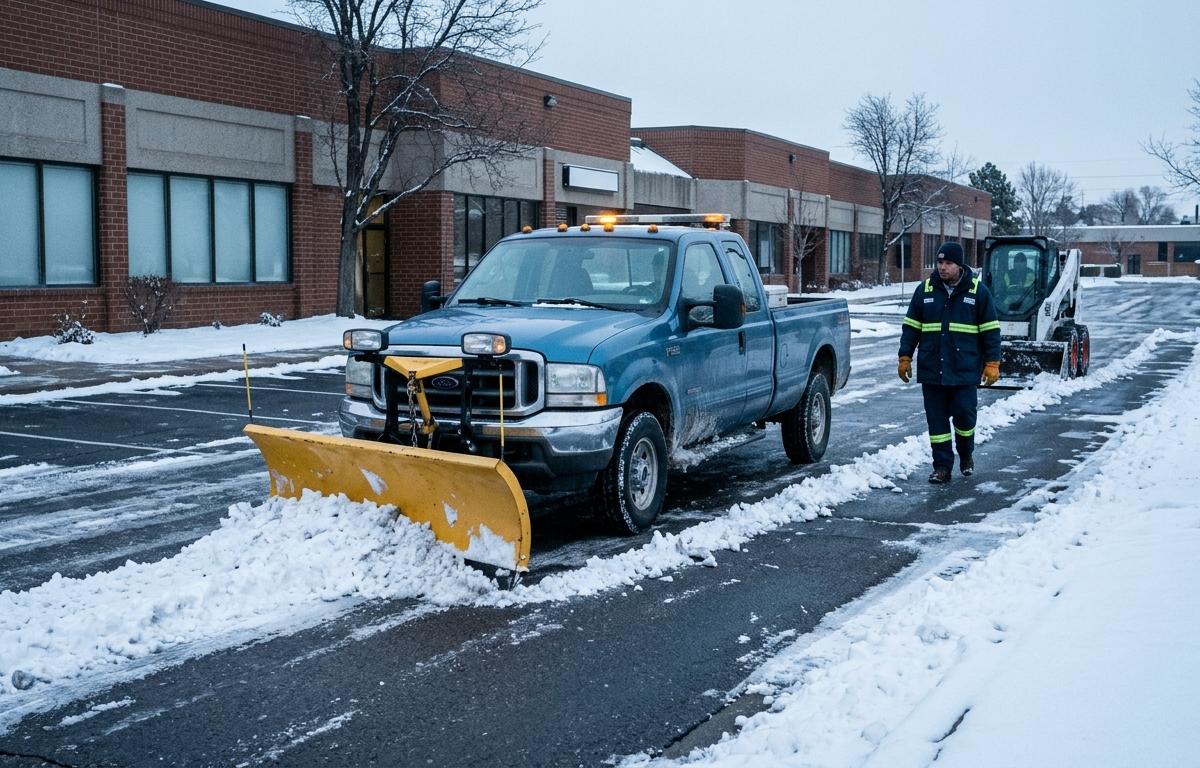
Who Is Responsible for Denver Lot Snow Clearing
If you own or manage a commercial lot in Denver, commercial parking lot snow removal denver is your problem. The city’s transportation department plows roughly 2,050 lane miles of main streets and clears around schools, according to the City and County of Denver’s snow program page. Private property is off the list. Parking lots, access drives, loading areas and the walks around your building stay with the owner, or with whoever the owner has put in charge.
Tenants don’t automatically take on that duty. Unless a written lease clearly and legally shifts snow responsibility, the landlord generally keeps it. For multi-tenant retail and office properties, that makes the lease language worth reading before the first storm, not after a claim lands on your desk.
Sidewalks run on their own clock. Local news coverage has reported that inspectors leave time-stamped notices on unshoveled walks, that businesses get a shorter window than residences before a fine, and that the baseline is clearing within roughly 24 hours after snow stops (Denver7, KDVR). Those articles aren’t new, so check current deadlines and fine amounts with Denver 311 or the transportation department instead of trusting a reprint. If you want the neighboring-lot angle, our guide to the best commercial snow removal for Denver business parking lots covers what to ask of a vendor.
Per-Push vs Seasonal Contracts and Trigger Depth
Two contract structures dominate commercial parking lot snow removal denver work, and the one you pick shapes both your cost and your place in the queue.
A per-push contract charges a fixed rate each time crews plow, once snow reaches an agreed trigger depth. You pay only for storms that actually happen. A seasonal contract charges a flat amount for the whole winter no matter how many storms arrive, so the budget stays predictable. Plenty of vendors blend the two, so ask what happens in a quiet winter and in a brutal one.
Trigger depth is where the real tradeoff sits. Colorado HOA law commentary notes that a higher trigger lowers your price but drops you down the vendor’s priority list in heavy snow, because crews service the one- and two-inch properties first (Colorado HOA law firm commentary). A three-inch trigger can look cheap on paper and feel slow in practice.
There’s also a gap below the trigger. A lot with a two-inch trigger doesn’t get serviced at one inch, yet freezing drizzle or a refreeze can turn a thin layer dangerous. Vendor-side reporting adds that during back-to-back storms, per-push clients are commonly the lowest priority while seasonal accounts get served first. Treat that as vendor-reported, not guaranteed, but it matches how crews logically route trucks.
For most commercial lots with customer or tenant traffic, a seasonal agreement with a low trigger, plus a clear provision for ice treatment under the trigger, tends to give the most predictable result. A per-push deal suits low-traffic lots where you can tolerate a delay. For a broader walk-through of how crews compare, see how to compare Denver snow removal crews.
What Pricing Looks Like for Small and Large Lots
Published Denver pricing for commercial parking lot snow removal is thin, and most of what exists comes from vendors, so treat any number as a rough benchmark, not a quote. One vendor-reported range, itself citing a third-party source, puts small commercial lots at about $125 to $350 per push, or roughly $3,000 to $8,000 per season. We couldn’t find a reliable published figure for large lots, and we won’t invent one.
What drives the price matters more than any headline number. The main variables are:
- Paved area and stall count, which set how long a truck needs to clear the lot.
- Trigger depth, since a lower trigger means more visits.
- Whether snow is stacked on site or hauled away, and how often.
- Walks, ramps and entrances that need hand shoveling and de-icing on top of plowing.
- Contract type, and whether ice treatment is bundled or billed separately.
A large lot isn’t just a small lot multiplied. Bigger surfaces often need multiple trucks, more stacking space and a hauling plan, and those operational decisions swing the bill more than square footage alone. The reliable way to price your site is a site walk and a written scope. Ask each bidder to price the same trigger, the same stacking plan and the same ice-treatment terms so the quotes line up. Related reading: what residential full-service clearing covers shows how scope differences change cost on smaller properties, and the same logic applies to lots.
Lot Operations: Stacking, Hauling, Fire Lanes and ADA Stalls
Where the snow goes decides how many parking spaces you have in February. Every commercial parking lot snow removal denver job needs a stacking plan before the first storm, not one improvised at 4 a.m.
Denver prohibits pushing, plowing or depositing snow into public streets, alleys and other rights-of-way (a vendor-reported summary of the rule, so verify the current ordinance text). You can’t solve a full lot by shoving snow toward the curb and into the road. Piles need to sit on your own property, in spots that don’t block drainage, sight lines or access.
Clear in this order of priority:
- Fire lanes and emergency access, which must stay open.
- Accessible stalls, the routes leading to them and ADA ramps.
- Main drive aisles and entrances.
- General parking stalls and secondary areas.
Accessible parking deserves explicit attention in your contract, because a pile that blocks an access aisle creates both a safety problem and a compliance one. Our explainer on the Denver ADA ramp snow clearing requirement covers the ramp side in more detail.
When piles start eating stalls, hauling is the answer. Hauling costs extra, so decide in advance what triggers it, such as a pile height or a stall-loss threshold, and how it’s billed. For melt products near entrances and hardscape, choose carefully, since some products damage concrete and pavers; see safe ice melt for pavers in Denver for what to avoid.
One note on timing: retail and office lots usually need clearing before opening hours, so ask each vendor how they sequence a storm and when crews typically finish.
Colorado Liability Limits (SB 18-062) and Documentation
Colorado’s Snow Removal Liability Limitation Act, SB 18-062, took effect August 8, 2018. It voids hold-harmless and indemnification language in snow and ice control contracts where the provider is prohibited from mitigating a specific snow, ice or mixed-precipitation event (Goodman and Wallace). The firm’s own example of a voided clause is a contract saying removal won’t occur until there are three inches of snow or more.
For property owners, the practical effect is that you can’t assume your vendor will absorb liability for a slip on your lot. The Act also leaves breach of contract and general negligence claims in place if a provider fails to deliver contracted services, so a vendor that skips visits can still be answerable. Be wary of any vendor guide that treats a blanket indemnification clause as non-negotiable without mentioning this limit. Have your attorney review contract language, since this article isn’t legal advice.
Because your own exposure can rise, documentation becomes your best protection. Keep a record for every storm:
- Time of arrival and time of completion.
- Which areas were plowed, shoveled and treated.
- Dated photos of cleared lots, walks and entrances.
- Complaints received and how you responded.
If a slip-and-fall claim lands months later, a time-stamped record of what was done and when is far more persuasive than memory. At Denver Snow Removal, our own practice is GPS-tracked trucks and photo proof of every visit, which produces exactly that kind of file. Ask any vendor you consider what records they hand over after each event. More on how tracking works is in our piece on a GPS-tracked snow plow company in Denver.
How to Choose and Vet a Denver Snow Removal Vendor
Start with the paperwork. A credible commercial vendor should show proof of general liability insurance and workers’ compensation coverage, and you should confirm the certificates are current instead of accepting a verbal assurance. Our licensed and insured snow plowing buyer guide lists what to request. Ask whether the people on your lot are employees or subcontractors, since subcontracted crews can complicate accountability and coverage. We use a licensed, insured W-2 crew with no subcontractors, which is our own practice, not an industry norm.
Then test the operations. Use these criteria when comparing bids:
- A written scope listing trigger depth, areas covered, stacking location and hauling terms.
- A defined response window and a plan for emergencies and overnight storms. Ours is a two-hour core response with 24/7 emergency service.
- A documentation process after each visit, ideally with timestamps and photos.
- Clear treatment of the below-trigger gap, such as ice control on request.
- Contract language that respects SB 18-062 instead of leaning on voided clauses.
- Local track record in Denver County, ideally with references from comparable lots.
Watch for red flags such as a price far below the rest, vague trigger language, or reluctance to put response times in writing; our list of snow removal red flags that slow down clearing goes deeper. If your property is multifamily, apartment complex snow removal in Denver covers the added tenant-facing issues.
Finally, do a site walk before you sign. A vendor who measures your lot, points out stacking areas and flags problem spots is likely to perform the same way in a storm. Whoever you choose, settle the contract before the first flakes fall, because the best crews fill their routes early. If you’re weighing options for commercial parking lot snow removal Denver properties depend on, get at least two written, like-for-like bids and compare scope, not just price.