How Denver’s City Snow Service Works (and Where It Stops)
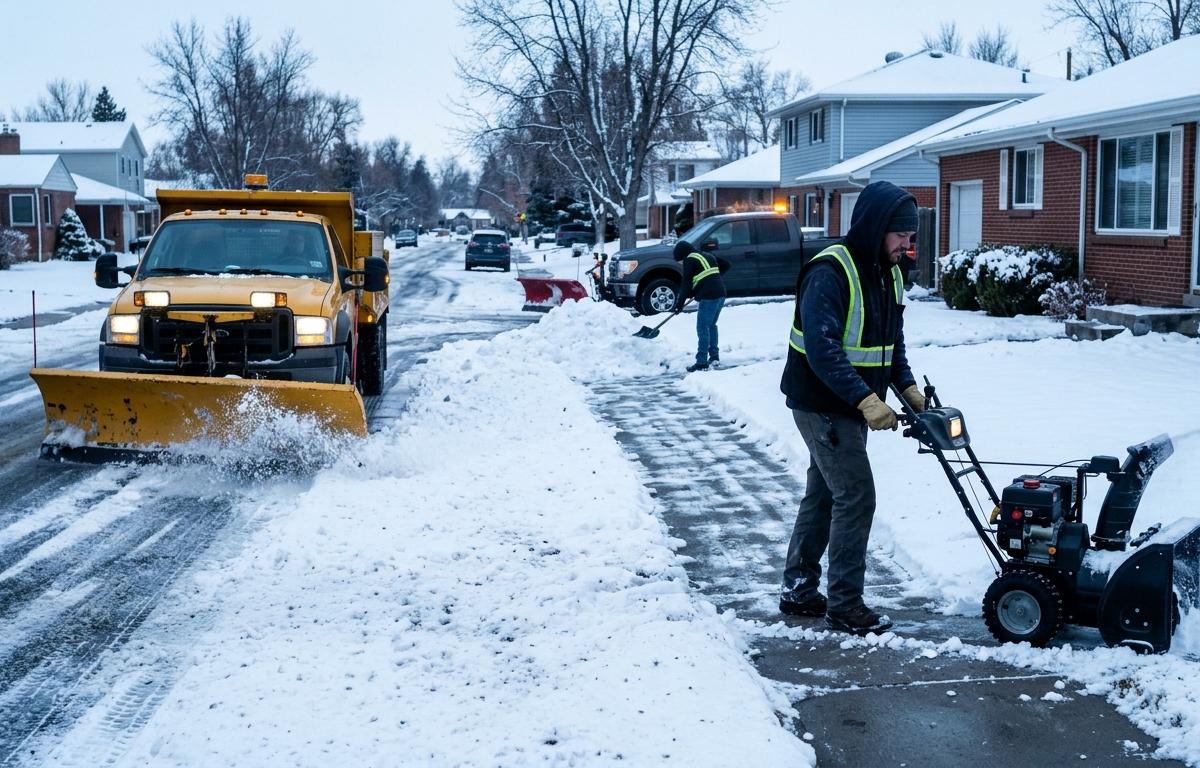
If you own or manage a property in the Highlands, start with a plain question about snow removal Highlands Denver: what do the city’s plows do, and what do they leave to you? Denver’s Residential Snow Plow Program grew out of the blizzards of 2006-07. It covers roughly 1,260 center lane miles of residential streets, worked by 4×4 pickup trucks with plows. According to the City and County of Denver’s snow removal page, residential plowing runs between 3:00 a.m. and 3:00 p.m., with one pass down the center of each side street. Those plows shave the top few inches off the snow pack. They don’t expose bare pavement, and residential streets get no de-icing materials.
That description sets your expectations. One center pass won’t clear your driveway apron, your front walk or the public sidewalk, and it can leave a windrow of heavy snow across your driveway entrance. Alleys are skipped too, because, as Westword’s plowing explainer notes, there’s no room to store the snow. Plenty of older Denver blocks depend on alleys for parking and garage access, so a lot of your property can end up effectively unserved.
One caution. The research behind this article doesn’t confirm exactly how the Highlands fits into the city’s residential plow pattern, and it holds no street-by-street Highlands data. What follows are the citywide rules that govern snow removal Highlands Denver properties, wherever your property sits. For a wider look at how the city and private crews split the work, see our overview of Denver snow removal. The live Denver snowplow map page explains what the city’s tracking tools do and don’t show.
The takeaway: city plows handle the middle of the street, on the city’s schedule. Everything between the street and your door is yours to clear or to hire out.
Sidewalk Rules, Notices and Fines You Need to Know
Sidewalk duty is where most snow removal Highlands Denver owners get caught off guard. Per the city, businesses must start clearing their sidewalks the moment snow stops falling, and residences have until the next day. Denver also expects owners to clear snow and ice from adjacent ADA ramps, a point covered in 9News’s rundown of the shoveling rules. Curb cuts are easy to forget, and our explainer on the Denver ADA ramp snow clearing requirement goes deeper.
Enforcement starts with a notice. An inspector leaves a time-stamped one, and from that moment a business has four hours and a residence has 24 hours before a re-check and a possible $150 fine. For the exact timing, read our guide to Denver sidewalk shoveling deadline rules.
Fines are uncommon in practice. Denver7 reported that between Dec. 23, 2022 and Jan. 17, 2023, inspectors issued 2,065 notices and only 45 turned into a fine. The city calls its approach education-first and asks residents to phone 311 to report an unshoveled sidewalk 24 hours after snowfall. That’s reassuring, but a notice still starts a clock. A landlord or HOA board that ignores one risks more than a fine if someone slips on an icy walk.
Two more points:
- If you or a neighbor physically can’t shovel, Denver’s volunteer Snow Angels program exists for exactly that situation.
- People often ask whether the city clears sidewalks itself. It doesn’t; see our answer on whether the City of Denver is responsible for sidewalks.
Some vendors also say Denver bars pushing snow into public streets and alleys, so it has to be stored on your own property. That claim comes from commercial sources, so check it against the municipal code before you rely on it. It does affect where a crew can put the pile on a tight lot.
What Snow Removal Costs in Denver: Ranges and What Drives Price
The research behind this article has no Highlands-specific pricing, so the honest answer is a citywide range with attribution. Angi’s Denver cost guide puts the average at $64 per visit, with most homeowners paying between $42 and $89. Seasonal contracts on the same source run $320 to $745 per year. Treat those as marketplace averages for a typical residential job, not a quote for your property.
Here’s what pushes the price up or down, based on how Denver providers generally describe their work:
- Surface area and layout. A short driveway plus a front walk costs less than a long drive and a corner-lot sidewalk wrapping two sides of the house.
- Terrain and surfaces. Steep grades and decorative surfaces that need specialized equipment cost more.
- Access. Older neighborhoods with tight lots, mature trees and narrow access points slow equipment down. One vendor lists the Highlands among such areas, but that characterization is vendor-sourced and unverified, so take it as illustrative rather than established fact.
- Timing. Early-morning, holiday and emergency calls usually carry a premium.
- Contract structure. Per-visit billing charges you every time crews show up. A seasonal flat rate gives you one price for the winter no matter how many storms arrive. Seasonal agreements commonly trigger at around two inches, and many providers want them signed before winter starts.
Larger properties price differently altogether. Condo and association work is usually quoted by paved area and scope; our piece on condo association snow removal in Denver covers how those contracts are structured, and commercial parking lot snow removal in Denver does the same for lots.
When you’re weighing per-visit against seasonal, the deciding factor is risk tolerance. A mild winter favors per-visit; a heavy one favors the flat rate. What you’re really buying is confidence that the walk is clear before the notice clock runs out.
How to Choose a Highlands Snow Removal Provider
Since the city stops at the center of the street, picking the right snow removal Highlands Denver crew is the real decision. Start with what protects you, then move to what shapes service quality.
Verify licensing and insurance. Ask for a certificate of insurance, not a verbal assurance. A slip on an icy walk can land on you, so confirm coverage is current and, where appropriate, names you. Our licensed insured snow plowing buyer guide lists what to request.
Ask who actually shows up. Some companies run their own employees; others sublet to whoever’s free. Find out whether crews are employees or subcontractors. Accountability is simpler when one company owns the job from dispatch to finish.
Look for proof, not promises. Providers with GPS-tracked trucks who send photo confirmation of each visit give you a record if a notice ever arrives. We explain why in our piece on a GPS tracked snow plow company in Denver.
Check trade credentials. Certifications from industry groups such as the Accredited Snow Contractors Association and the Snow & Ice Management Association show up in Denver provider listings. They aren’t a guarantee, but they suggest a company takes the work seriously.
Match the scope to your site. Ask specifically about alleys, ADA ramps, steps and where the snow will be piled. A crew that quotes only the driveway may leave your sidewalk and curb cut to you.
Think about de-icing. The city puts no de-icing materials on residential streets, so ice on your own surfaces is your job. Material choice matters, especially on pavers; see our guides on salt versus magnesium chloride and safe ice melt for pavers.
To compare candidates in a structured way, our vetting guide for residential snow removal before the first storm and how to compare crews give you questions to ask, and our list of red flags that slow down your clearing shows what to walk away from.
Documentation, Response Time and Next Steps for Highlands Properties
Once you’ve picked a provider, get three things in writing: what triggers service, how fast the crew will arrive, and what proof you’ll receive.
Trigger depth. Many seasonal agreements kick in at about two inches. Confirm the number, and ask what happens with repeated light snow or drifting.
Response time. Ask for a specific window, not "as soon as possible." Remember the clock: a residence has until the next day after snowfall stops, and once a notice is left, only 24 hours before a re-check. A crew that turns up two days later does you no good. A Denver County provider that promises a defined core response time and round-the-clock emergency service gives you something concrete to hold them to.
Documentation. Photo proof and GPS logs of each visit do two jobs. They show the walk was cleared when the storm ended, and they give you evidence if you ever dispute a notice or face an injury claim. For landlords and rental owners, that paper trail may be worth more than the shoveling itself. Our guide to residential snow removal services for landlords and rentals covers what to keep on file.
A simple sequence to follow before the next storm:
- Measure your driveway, walks, steps and ADA ramp, and note whether you depend on an alley.
- Choose between per-visit and seasonal billing based on how much storm-to-storm uncertainty you can live with.
- Collect at least two written quotes that spell out trigger depth, response window and documentation.
- Confirm insurance and crew status before signing.
- Sign before the season is underway, since providers tend to fill seasonal rosters early.
If you’d like a snow removal Highlands Denver provider built around these points, Denver Snow Removal is a family-owned, Denver-based company operating since 1974 and serving Denver County with plowing, shoveling and de-icing for homes, HOAs, landlords and commercial lots. It uses a licensed, insured W-2 crew with no subcontractors, GPS-tracked trucks, photo proof of every visit, a 2-hour core response and 24/7 emergency service. Compare that against any quote you collect, and decide before the storm arrives, not after the notice does.