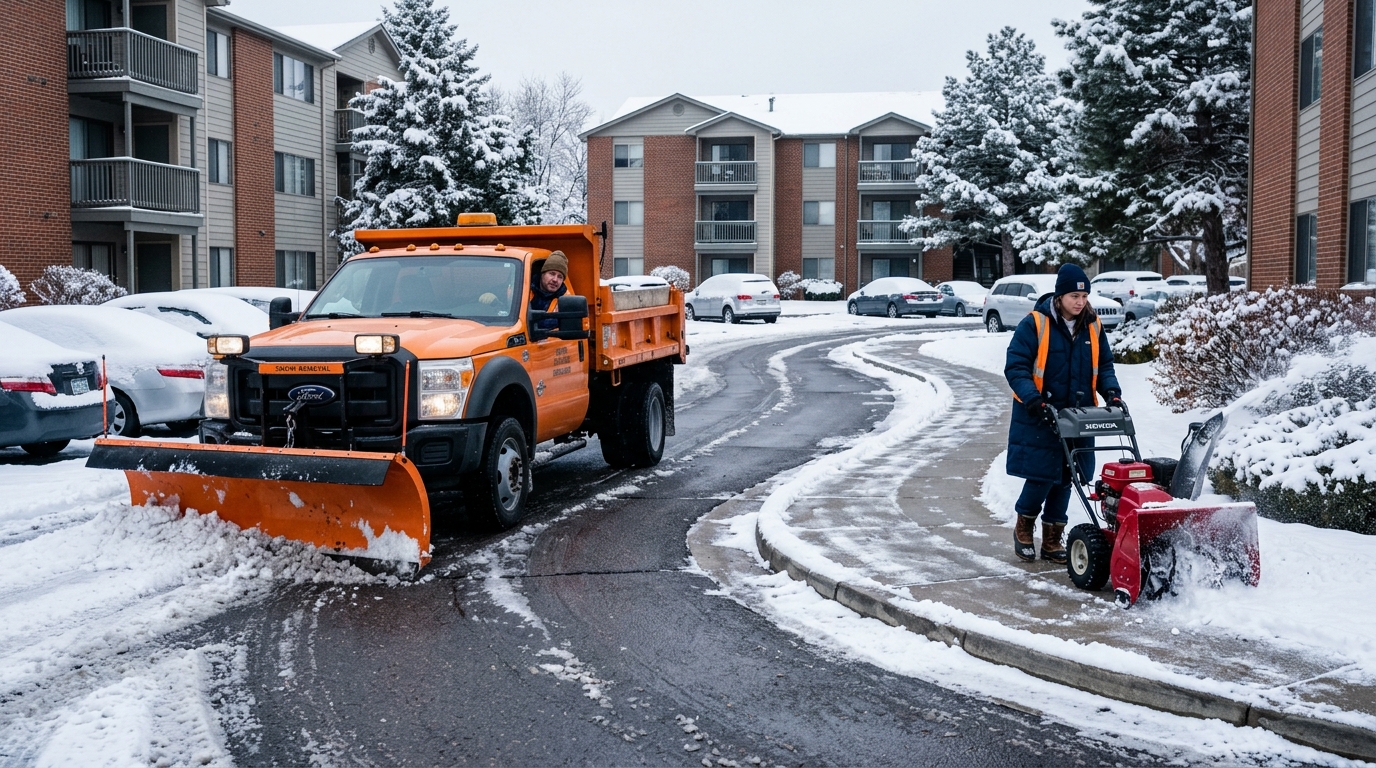
Who Is Responsible for Snow Clearing at Denver Apartments
If you own or manage a multifamily building, the plan for snow removal for apartment complex denver properties starts with a plain fact: the city does not clear private property. Denver’s transportation department plows about 2,050 lane miles of main streets with a fleet of 70 large plows, and it plows around schools to create safe zones for children, according to the City and County of Denver snow page. Your parking lots, drive aisles, fire lanes, entry walks and mailbox areas are yours to clear.
Sidewalks are where owners get caught. Denver7 reports that inspectors first leave a time-stamped notice at a property with an unshoveled sidewalk. After that, businesses have 4 hours and residences 24 hours before an inspector can issue a $150 fine (Denver7). Older coverage from KDVR describes inspectors marking uncleared sidewalks and writing citations when they circle back, though that article is dated. Published sources differ on the exact wording, so confirm the current clock with Denver 311 or the transportation department instead of building your whole plan on one news story. The city also encourages residents to call 311 about an unshoveled sidewalk 24 hours after snow stops. That means neighbors and tenants can trigger an inspection on you.
Who carries the duty inside a rental? Vendor guidance generally says it falls on the owner or manager unless a written lease explicitly and legally transfers it to tenants. Treat that as a rule of thumb, not settled law, and have your attorney review any lease language that shifts snow duty to residents. For a multi-building complex with shared paths, handing the work to tenants is rarely realistic anyway. A contracted crew with a clear scope is the safer route. For a wider look at how local rules and crews fit together, see our guide on how snow plowing works in Denver.
Colorado Liability Limits and Your Contract Terms
Plenty of property managers assume the vendor will absorb the risk of a fall on ice. Colorado law is more specific than that. The Snow Removal Service Liability Limitation Act, effective August 8, 2018, voids hold-harmless and indemnification language in snow and ice contracts where the provider is prohibited from mitigating a specific event. Goodman and Wallace offers a clear example of a voided clause: a contract that says no service happens until there are 3 inches of snow or more.
Read that carefully, because it cuts two ways. A contract that says "we plow at 3 inches, and you indemnify us for everything before that" isn’t enforceable as written. But the same law doesn’t shift the risk onto your vendor. As the firm notes, the Act does not rule out breach-of-contract or general negligence claims when a provider fails to deliver the services it was hired to perform. Your exposure as owner doesn’t vanish. It changes shape.
Some vendor guides push a blanket indemnification clause as non-negotiable. That advice is in tension with Colorado’s rule for trigger-limited contracts, so don’t repeat it to your board or ownership group without checking it against the statute. Have counsel review the indemnity, insurance and trigger language before you sign. If a vendor’s standard form lists a trigger depth and also asks you to hold them harmless for conditions below it, that’s a flag. For more on spotting weak terms, see our piece on red flags that slow down your clearing.
Terms worth asking for: a named trigger depth, a stated response window, a defined scope of surfaces (lots, walks, ramps, dumpster pads, bus-stop frontage if applicable), an ice-treatment provision, a certificate of insurance naming your entity, and a clear statement of what happens when back-to-back storms stack up.
Contract Structures: Per-Push vs. Seasonal Flat-Rate and Trigger Depth
Two structures dominate. A per-push (or per-event) contract charges a fixed rate each visit once the trigger depth is reached. A seasonal flat-rate contract charges one fee for the whole winter, no matter how many storms arrive. Neither wins in the abstract. They fit different priorities.
Per-push suits owners who want to pay only for work actually done and can live with a variable winter budget. In a light season it can come out cheaper. In a heavy one the invoices pile up, so you need a reserve. Seasonal flat-rate suits owners who need predictable numbers for an operating budget or an owner report. The vendor takes on the weather risk, which is why the quote usually has that risk priced in. Ask whether the flat fee covers every plow visit and every de-icing pass or only plowing, and whether there’s a cap on visits per season or per storm.
Trigger depth deserves its own decision. A Colorado HOA law firm lays out the tradeoff plainly: a higher trigger such as 3 inches lowers your cost, but your property slides down the vendor’s priority list in a heavy snowfall, because crews serve the 1- and 2-inch trigger properties first (Colorado HOA law firm). For snow removal for apartment complex denver properties, with residents heading out early for work and emergency vehicles needing access, a low trigger is usually worth the extra money. Ask how the vendor handles accumulation that falls short of the trigger but refreezes into an ice sheet.
Pricing for large complexes is hard to find in published sources. What vendors publish tends to cover small lots, so don’t count on a reliable number from an online search. Cost is driven by paved area, total walkway length, trigger depth, whether snow must be hauled off rather than stacked, and how much de-icing you want. Get written bids from at least three vendors against the same scope so the numbers compare fairly. Our guide on how to compare crews in 2026 walks through that process.
Tenant Communication, Lease Language and Resident Vehicle Moves
Most apartment-snow complaints are communication failures, not plowing failures. Tenants don’t know when the crew is coming, where to park, or who to call about an unshoveled walk. Fix that before the first storm.
Put the snow rules in writing and send them out in fall. Say who clears what, when residents should expect service, where they can park during plowing, and how to report a problem. If your lease addresses snow, keep the language factual and have counsel confirm it, since a lease that tries to push the duty onto residents may not hold up and can undercut your own position. A short notice in the resident portal, a posted sign at each building entrance and a text or email alert when a storm is forecast cover most households.
Vehicle moves are the next friction point. A plow can’t clear a lot full of parked cars, so unplowed stripes and buried bumpers become the vendor’s problem, then yours. Decide in advance how many hours’ notice you’ll give, which areas get cleared first, and where cars can temporarily relocate. If your property has a guest lot, a nearby overflow area or a rotating schedule by building, tell residents ahead of time. Rules for street parking during major storms are separate, so point residents to the city’s snow emergency parking ban information so they aren’t caught off guard on public streets.
One more rule to build into your stacking plan: Denver prohibits pushing or depositing snow into public streets, alleys and other rights-of-way, according to vendor-reported sources. Plan snow storage on site. If space is tight, price hauling into the contract rather than discovering the problem mid-storm.
Documentation, Response Times and Choosing a Vendor Before the First Storm
If someone slips on your property and files a claim, your best defense is a record. Ask any vendor you’re considering for time-stamped visit logs, before-and-after photos and GPS records for each visit. These documentation standards rest mainly on industry guidance rather than a neutral legal source, but a record of timely service is still the most useful evidence you can have when a claim arrives. Make documentation a contract term, not a favor, and ask how quickly you’ll receive it after each storm.
Response times matter just as much. Ask for a stated window from when the trigger depth is reached to when the crew arrives, and ask what happens if two storms land back to back. For a multi-building complex, find out how the vendor sequences routes, which areas get cleared first (fire lanes, accessible paths and main entries should lead), and how they treat ice after plowing. A vendor who can describe their sequence in detail has probably run it before.
Choose your snow removal for apartment complex denver vendor before the first storm, not during it. Late summer through early fall is the right window. Verify insurance, confirm whether the vendor uses its own employees or find out who the subcontractors are, and check that its service area actually covers your block. Crews based outside the county can lose time on the road, a point we cover in why Denver County-only crews respond faster. For a fuller walk-through of what to check, our vetting checklist for Denver snow removal services applies equally well to multifamily properties.
A simple way to choose is to score each bid on five points: written trigger depth, response window, scope coverage, documentation delivered, and insurance and contract terms reviewed by counsel. The cheapest bid that fails two of those five usually costs more by February.