Why Rock Salt Damages Pavers and Natural Stone
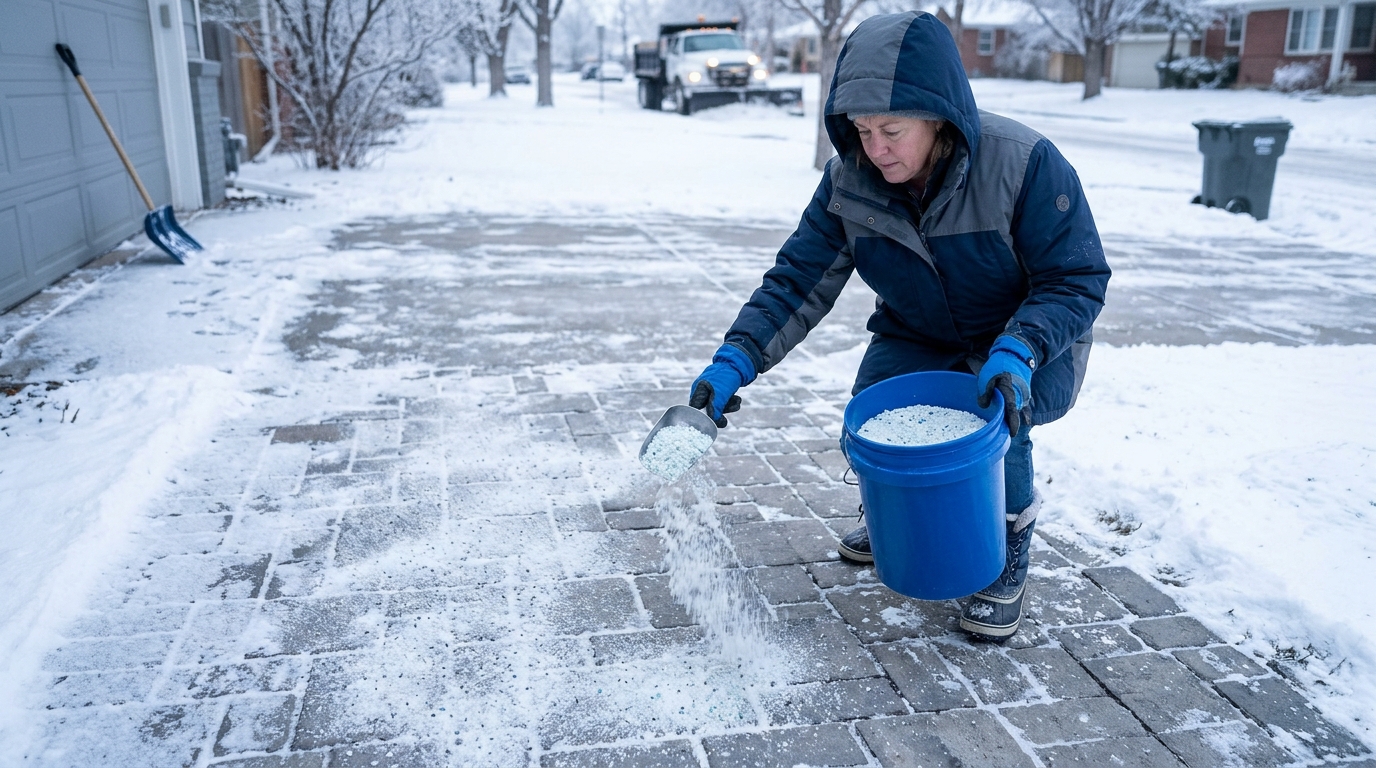
If you manage pavers in Denver, the first rule of safe ice melt for pavers is simple: keep plain rock salt off them. The salt itself isn’t the real culprit. The water is. Melted brine soaks into porous pavers and natural stone, then refreezes, and each freeze makes it expand inside the surface. After a winter of that, the pressure shows up as flaking, spalling and cracking. As Lurvey notes, pavers and natural stone are at risk for spalling and cracking when exposed to the wrong product.
Denver makes this worse. Our weather swings from sunny afternoons to freezing nights, so a walkway can thaw, soak and refreeze in a single day. That cycle is the damage engine, and choosing safe ice melt for pavers in Denver means picking the product that decides how much moisture gets driven into the surface and how often it freezes again.
Rock salt also hits a performance ceiling. Sources disagree on where it quits: one puts the cutoff near 15°F, another closer to 25°F. Don’t bet on a single number. Once a real cold snap arrives, assume rock salt has stopped working. A product that fails in the cold tempts people to pile on more, and over-application is how pavers and the plants beside them get hurt.
Dry-looking pavers aren’t safe pavers, either. Pavers are porous by design, which lets them drain, and those same pores trap meltwater. The goal isn’t to avoid ice melt entirely. It’s to choose a product and a rate that don’t leave soaked, refreezing surfaces behind.
Ice Melt Options Compared: Calcium Chloride, CMA, and Magnesium Chloride
Three products come up most often as safe ice melt for pavers in Denver, and each comes with a clear trade-off.
Calcium chloride is best for deep cold. It keeps working at very low temperatures, with one source citing performance down to -25°F, and it helps limit refreezing. The downsides are real, though: it can leave a white powdery residue, and it carries corrosion risk when over-applied. Used lightly and measured, it’s a strong choice for Denver’s coldest mornings.
Calcium magnesium acetate (CMA) is the pick when gentleness matters most. It’s frequently named the safest option for pavers, and it tops pet-safety lists too, though those lists often come from product sellers, so weigh the claim accordingly. CMA works at about 20°F and below, but it can leave slush behind and loses effectiveness as temperatures drop further. It suits a homeowner with decorative pavers who can wait a little longer for results and will shovel the slush away.
Magnesium chloride sits in the middle. It handles lower temperatures than CMA and is gentler than rock salt. Sources disagree on its floor, with figures ranging from -5°F to -15°F, so check the bag label for the exact rating before you rely on it. Treat it as a middle path, not a miracle.
Several guides also cover blended products, which mix these chemistries to balance cost, speed and surface safety. If you go that route, read the ingredient list rather than trusting the front of the bag, because "paver safe" is a marketing phrase, not a standard. The best chemical choice still depends on the paver itself. Concrete, clay brick and natural stone don’t all tolerate the same products equally, so when in doubt, test a small, out-of-sight spot or ask the paver installer.
One habit pays off whatever you use: shovel first. Clearing as much snow as you can means you spread less melt on a thinner layer of ice, which is better for the surface and cheaper for you. Our guide to de-icing services in Denver and when ice melt beats another snow push covers how to decide whether melt is even the right tool.
Temperature Limits and Denver’s Cold Snaps
Every ice melt has a temperature below which it slows down or stops, and Denver doesn’t stay mild all winter. A product rated to 20°F will do fine on a bright 28-degree afternoon, then disappoint during the overnight low. That mismatch is why people end up reapplying, which circles back to over-application.
Use the ratings above as a rough map. CMA is a milder-temperature choice, effective around 20°F and below but fading in a hard cold snap. Magnesium chloride reaches lower, though the published floors vary. Calcium chloride goes lowest of all, with one source citing -25°F. Rock salt is weakest in the cold, which is one more reason to keep it off pavers: when it fails, the temptation is to keep adding.
In practice, match your safe ice melt for pavers in Denver to the forecast, not the calendar. If the overnight low will sit well below 20°F, a CMA-only plan may not keep the walkway clear. Consider a lower-temperature product used sparingly, or a blend. If temperatures hover near freezing, a gentler product is enough and the pavers will thank you.
Timing matters too. Melt works best when applied before or early in a storm, and it does poorly on thick, packed ice. Heavy ice usually needs mechanical clearing first. For fast, documented response when a storm is already on top of you, our snow removal services in Denver for homes, HOAs and commercial properties include de-icing as part of the visit.
Pet Safety, Residue, and Slip Risk
"Paver safe" and "pet safe" are two different claims, and a bag can carry one without the other. Be skeptical of absolutes. One pet-product seller states plainly that no de-icer is entirely safe for pets because most contain some form of salt. CMA is widely described as the gentlest on paws, while standard calcium chloride can irritate or burn them and can be harmful if ingested. Many of these statements come from vendors, so treat them as guidance and check the label for the manufacturer’s own pet advice.
Residue deserves attention beyond pets. Calcium chloride can leave a white powder that tracks indoors and dulls the look of pavers. CMA can leave a slushy film. Neither is a disaster, but both mean you should sweep or rinse once the ice is gone, rather than letting residue sit and soak in.
Slip risk is the part many owners overlook. Slush from a gentle melt can refreeze overnight into a glassy sheet, so a "safe" product can still leave a hazardous walkway if you stop at spreading. Check the surface again after dark in cold weather and clear any leftover slush. If animals share your walkways, see our guidance on pet-friendly ice melt in Denver and non-corrosive options for walkways.
Rate control ties all of this together. More product doesn’t mean faster melting. It means more residue, more paw exposure and more load on the surface. A light, even layer on shoveled pavement beats a heavy pile on packed snow every time.
Choosing Ice Melt for Rentals, HOAs, and Commercial Lots: Crew-Applied vs. DIY
For a single homeowner, DIY application is manageable. For rentals, HOAs and commercial lots, the calculus shifts, because the questions become liability, consistency and proof.
DIY works when one person controls one set of pavers, knows the paver type and can watch the weather. The risks are over-application, grabbing whatever is on the shelf, and keeping no record of what was done. At a multi-unit property, those risks multiply across tenants, each of whom may buy a different bag.
Crew application gives you one product choice, a controlled rate and a repeatable routine. For landlords, that consistency protects both the surface and your position if someone slips. For HOA boards, it means common-area pavers get the same treatment every storm instead of whatever a volunteer had in the garage. Our crew is licensed and insured, uses no subcontractors, and documents each visit with photo proof and GPS-tracked trucks, the paper trail a property manager wants. It’s worth reading how this plays out in snow removal for apartment complexes in Denver and condo association snow removal in Denver.
How to choose: use these criteria.
- Surface type: decorative pavers or natural stone call for the gentlest product; plain concrete is more forgiving.
- Forecast range: pick a product whose rating covers your typical overnight lows.
- Occupants: pets and children push you toward lower-irritation options.
- Property scale: the more units or lot area, the stronger the case for crew-applied, documented service.
- Proof needs: if you must show what was done and when, choose a provider that supplies photo records.
Start with the surface and the forecast, then decide who applies it. For a broader look at vetting providers, see our checklist on vetting a Denver residential snow removal service before the first storm.