What the City Covers and What Your School Must Cover
Start with the line between public and private pavement, because it decides who is responsible for school parking lot snow plowing Denver campuses depend on when a bus pulls up to an icy loop at 7:15 a.m. The city’s transportation department plows main streets and, according to its snow removal program page, plows around schools to provide safe zones for school children. That language describes the public street. It says nothing about your lot.
Vendor sources in the research state that the city does not clear private property, and that parking lots belong to the owner. Treat that as vendor-reported and confirm it with 311 or the Department of Transportation and Infrastructure. Still, it matches how city programs work everywhere: the curb is the boundary. Everything past it is the school’s job to keep clear, whether staff do the work or a contractor does. That means staff parking, visitor stalls, drop-off lanes, bus loops, fire lanes and the walks between them.
A second boundary matters just as much when you write a plan. Vendor-reported guidance says Denver prohibits pushing or depositing snow into public streets, alleys and rights-of-way. If that holds under the current code, a school can’t solve a crowded lot by shoving piles toward the road. Your contractor needs a designated stacking plan on the property, and your bid documents should say so plainly.
One caution about evidence. The research turned up no Denver Public Schools or other Colorado district snow bid, so the specifications discussed below come from school RFPs in other states. They’re useful as procurement norms, not as Colorado requirements. Public districts in Colorado also follow their own purchasing rules, so check with your procurement office before borrowing language.
If you’re weighing providers generally, our guide to the best commercial snow removal for Denver business parking lots covers the commercial side. A school adds a hard clock, which is the next thing to pin down.
What a School Snow Plowing Contract Should Specify
A bid for school parking lot snow plowing Denver districts issue should read less like a price quote and more like an operating procedure. Vague scopes breed disputes at exactly the wrong moment, so spell out each of the following.
Defined areas. Attach a site map marking every lot, bus loop, drop-off lane, fire lane, ADA space, ramp and walkway, with a priority order for each. Contractors price paved area and walkway length, so a map also keeps every bidder pricing the same campus.
Trigger depth. State the snowfall depth that starts service and whether drifting or ice triggers a visit regardless of depth. West Ottawa’s bid, for instance, requires plowing by 6:00 a.m. whenever snow reaches two inches or drifting occurs. There’s a Colorado wrinkle here. According to Colorado HOA law commentary in the research, a 2018 state act voids hold-harmless language in snow contracts where the provider is barred from treating a specific event, such as waiting until three inches fall. Have counsel review any indemnity wording and any trigger threshold before you sign.
Service types and sequence. List plowing, shoveling, de-icing and any return visits to re-clear after buses and drop-off traffic have packed the surface.
Crew and subcontracting. Regional School District No. 4 bars outside subcontractors and allows termination if the contractor’s failure delays or closes school. You may not want identical terms, but decide on purpose whether the company you hire does the work itself. Ask for proof of licensing and insurance, and ask how crews are employed.
Documentation. Require time-stamped records of each visit, ideally with photos, so you can reconcile invoices and answer a parent or board question about what happened on a given morning. GPS records help here too, and we explain what to look for in a GPS-tracked snow plow company.
Billing on odd days. Say how you pay when classes are delayed or cancelled but staff still report, and how you pay for storms that arrive on weekends. Pricing varies with campus size and trigger depth. The research found no published school pricing, so expect to compare structured quotes rather than a single going rate.
Pre-Bell Deadlines, Bus Loops and Staff Lots
Timing is the heart of school work. A shopping center can wait out a slow morning. A school has a daily deadline that doesn’t move because the weather did.
The sample RFPs show how districts express it. Lebanon Public Schools requires staff parking areas to be cleared by 6:00 AM regardless of school delays or cancellations, which acknowledges that employees often arrive before any announcement is final. Detroit Public Schools uses tiered deadlines instead: 5:30 a.m. for bus terminals and 6:00 a.m. for high schools, with elementary and middle schools half an hour before bell time. Tiering makes sense because the first vehicles on a campus are usually buses and custodial staff, not students.
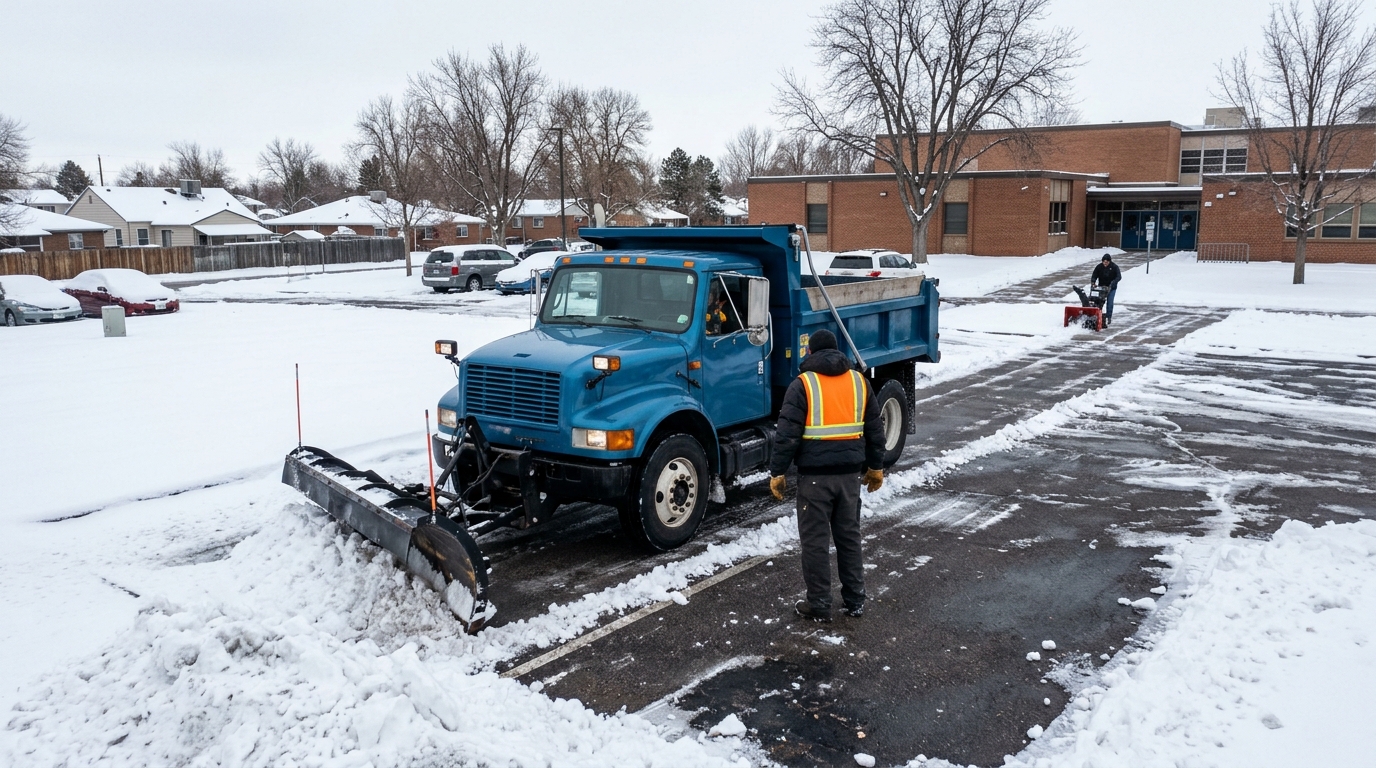
For school parking lot snow plowing Denver planning, translate those models into your own schedule. Work backward from the first arrival, not the first bell. Name the earliest vehicles that need clear pavement, typically buses, then maintenance and kitchen staff, then teachers, then parent drop-off. Give each zone a clear-by time.
Sequence matters as much as the deadline. A sensible order puts bus loops and fire lanes first, then staff lots, then the drop-off lane and visitor parking, and finally the full campus, with shovel crews handling walks and entrances in parallel. If your plan only says "clear by 6 a.m.," a contractor with several accounts can satisfy the letter of it while leaving the bus loop for last.
Ask bidders how they staff a storm that lands overnight, how many trucks they can put on your site at once, and what happens if a second storm arrives before the first is cleaned up. A company that answers in specifics, with a response standard it can document, is easier to trust than one that promises everything. For context on how a Denver contractor frames response commitments, see our look at snow removal companies, COIs, response times and site maps.
Stacking, Ice Melt and Liability Rules to Check
Where snow goes, and what goes on what remains, create most of the avoidable problems on school property.
Stacking. Lebanon’s RFP bars snow piles on sidewalks or walkways, against buildings or fences, on emergency generators or fuel tanks, and on adjoining properties or public roadways. Adopt those almost verbatim, with local additions. Keep piles out of sight lines at driveways and crosswalks, away from storm drains so meltwater doesn’t refreeze across a lane, and clear of fire hydrants and bus stops. Mark a stacking area on your site map and require the contractor to haul off excess if it fills, with the hauling price stated in advance. Given the vendor-reported Denver ban on pushing snow into public streets, a lot with little room can’t skip hauling.
Ice melt. Decide in advance where de-icing material is acceptable and where you want hand application or limited use, such as near planters, turf edges and building entrances. The research found no Colorado school policy on magnesium chloride or other products near entrances, so write your own and have the contractor confirm in writing which material it uses. Ask who supplies it, how much goes down per visit, and whether you’re billed by the application or by the pound.
Liability and insurance. Require a current certificate of insurance for every school parking lot snow plowing Denver contract, naming the school or district as an additional insured, and confirm the coverage limits with your risk manager. Be careful with indemnification language. Colorado’s 2018 snow liability act, described in Colorado HOA law commentary, voids certain hold-harmless clauses in trigger-limited contracts, yet it doesn’t remove claims for breach of contract or negligence if a provider fails to deliver contracted services. Some vendor guides tell customers to demand blanket indemnity as non-negotiable. Don’t rely on that without legal review.
Sidewalks. Walks and ramps around the building carry their own exposure. Vendor and local news sources describe city sidewalk deadlines, but the wording varies and the reports are dated, so confirm current requirements with Denver 311 or the transportation department. Our summary of the Denver sidewalk snow removal law is a starting point, not a substitute for the city’s current rules.
How to Compare Bids and Choose a Denver Contractor
Once you have a written scope, comparing bids is mostly a matter of reading them against it.
Normalize the quotes. Give every bidder the same site map, trigger depth, clear-by times and billing assumptions. Then compare structure, not just totals. A per-push price, a seasonal flat fee and a hybrid can look wildly different until you model them across a mild winter and a heavy one. Ask each bidder to show the figure under both so you can see where the risk sits. Expect school parking lot snow plowing Denver pricing to follow paved area, walkway length and trigger depth rather than a fixed rate. No published school pricing surfaced in the research, so don’t trust a number quoted without seeing your map.
Test the answers behind the price. Ask for references from other campuses or large lots, and call them. Ask how the company dispatches, how many crews it can field in a major storm, and how it proves a visit happened. A contractor that offers a response standard in hours, trucks tracked by GPS and photos of completed work gives you records to hold it to. A bidder that can’t describe how it documents work will be hard to audit later.
Weigh priority and thresholds. Colorado HOA law commentary notes that properties with lower trigger depths get served first in a heavy storm, while higher thresholds cost less but fall lower in vendor priority. For a school with a firm morning deadline, a higher trigger threshold may save money and cost you the one thing you can’t afford, which is a clear lot at 6 a.m.
Check termination and failure terms. Look for a clause that lets you end the agreement, or hire a backup, if the contractor’s failure delays opening. Regional School District No. 4 includes this, and it gives the district leverage.
Match the contractor to the campus. Local knowledge shortens response times and shows where drifting happens. If you manage several properties, our overview of snow removal services in Denver for homes, HOAs and commercial properties shows how a single provider can handle different property types. When the bids are in, select on documented performance and clear terms, then put the winner on a written plan before the first forecast arrives.