What a Denver Snow Emergency Parking Ban Is and Where It Started
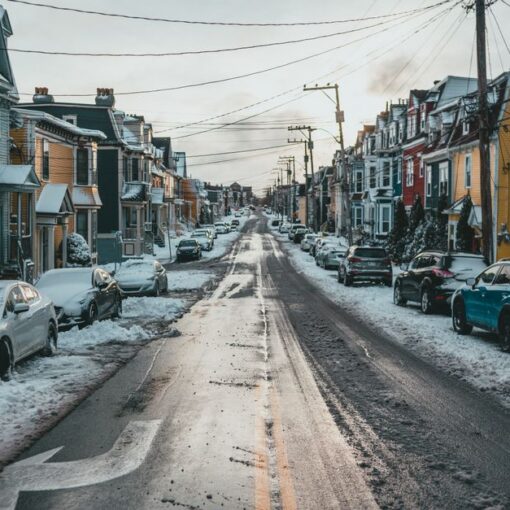
A snow emergency parking ban is a temporary rule that keeps certain streets clear of parked cars so plows can reach the full width of the road. In many American cities it works as a set period with specific parking restrictions, signed snow routes and towing for anyone who ignores them, according to the general overview of a snow emergency. That’s the generic idea. It’s a fair starting point, but it doesn’t describe how Denver handles things today.
Denver’s own history with the idea of a snow emergency parking ban is short and specific. Mayor Hickenlooper announced the city’s first-ever snow emergency parking ban on Dec. 28, 2006, after the storms that tested the city that winter, as recounted in the Denver Public Library’s history of snow removal in Denver. That date is the anchor fact. It tells you the ban is a tool the Mayor’s office can reach for, not a standing rule that switches on with every inch of snow.
One vendor explainer says the Mayor’s office declares the emergency and that snow emergency routes carry red-and-white signs. Treat that as one company’s claim about the Denver snow emergency parking ban, not something the city has confirmed. The official Parking Ordinances page doesn’t list a snow-emergency rule in the excerpts available, so the current declaration process, the mapped routes and the penalty amounts can’t be verified from an official page. We’d rather say so plainly than hand you a confident-sounding rule that turns out to be wrong on the morning you move your car.
How to Check Whether a Ban Is Active Right Now
When you’re standing at the window wondering whether to move the car, you need a current source, not a blog post. The safe reference points are the city’s own channels: the Snow Removal pages at denvergov.org, Denver 311, and the signs on your block. If a Denver snow emergency parking ban is in effect on a given street, posted signage is what you’re legally expected to follow, so a quick walk to the corner is worth more than any secondhand summary.
The city’s Snow Removal page is the place to start for plowing information. It also points to Denver’s snow route mapping, described as a GIS page showing current snow routes. Whether that map is the right place to confirm a parking ban, as opposed to showing plow routes, we couldn’t confirm. Use it as a clue about where plows are heading, not as proof that parking is restricted.
A few habits help:
- Check the city’s snow page and 311 before a forecast storm, not after the first plow has gone by.
- Look at the signs on your own street and the nearest main street. Posted restrictions control.
- Don’t assume a rule that applied last winter applies this winter. Declarations are at the city’s discretion.
One more caution: if you search for this topic, many top results are about other cities that share a name with Denver or sit in other states. Make sure whatever you’re reading is about the City and County of Denver, Colorado, not a similarly named place with its own rules.
Ticket and Tow Risk: Parking Rules Still Apply in a Storm
A storm doesn’t suspend ordinary parking enforcement. In a 2019 report, CBS Colorado quoted Denver Public Works saying that even during a snowstorm, parking rules are enforced and drivers can be ticketed. Heavy snow is no free pass to leave a car blocking a hydrant, a crosswalk or a posted no-parking zone.
What we can’t give you is a verified tow fee or a current ticket amount tied to a Denver snow emergency parking ban violation. Those figures weren’t confirmed in the official material, and quoting a number from memory would mean inventing one. If cost matters to your decision, the official parking and towing pages and 311 are where to confirm it.
There’s also a plowing reason to move a car even when no ban has been declared. Denver’s residential plowing is a single pass down the center of side streets, triggered at the discretion of the Mayor’s office and the Department of Transportation and Infrastructure during major snow events, as described on the city’s Snow Removal page. A car parked tight against a narrow street can make that pass harder, and you may find a berm of packed snow against your wheels afterward. Moving the vehicle before the plow comes protects you from getting boxed in as much as from a citation.
Storm-Day Checklist: Parking, Plow Timing and Your Sidewalk Duty
A ban only covers the street. Your own frontage is a separate responsibility, and it’s the one people forget while they’re busy with the car. Here’s a simple order of operations for a storm day.
Before the snow
- Check the city’s snow page and 311, and scan your block for posted restrictions.
- Decide where the car goes if you have to move it, ideally off the street.
- Pre-treat walkways if you can. The city encourages putting down de-icer ahead of a forecast storm because it makes removal easier.
While it falls
- Expect the residential plow to make one center pass, not to leave bare pavement. It shaves the top of the snow pack and doesn’t carry de-icing material, so don’t expect a cleared street.
- Keep in mind that plowing can push snow onto your sidewalk and driveway. The city treats that as an unfortunate side effect of clearing the street.
After it stops
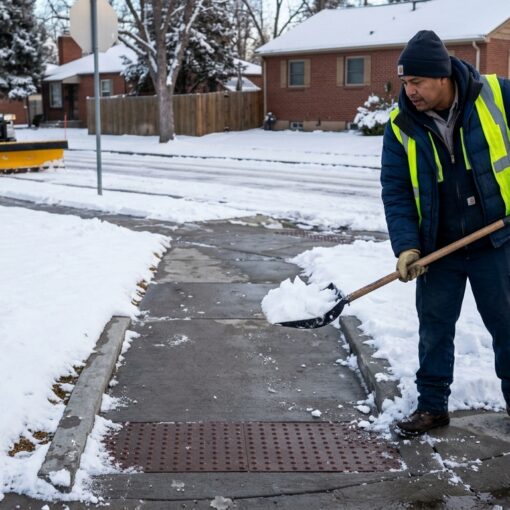
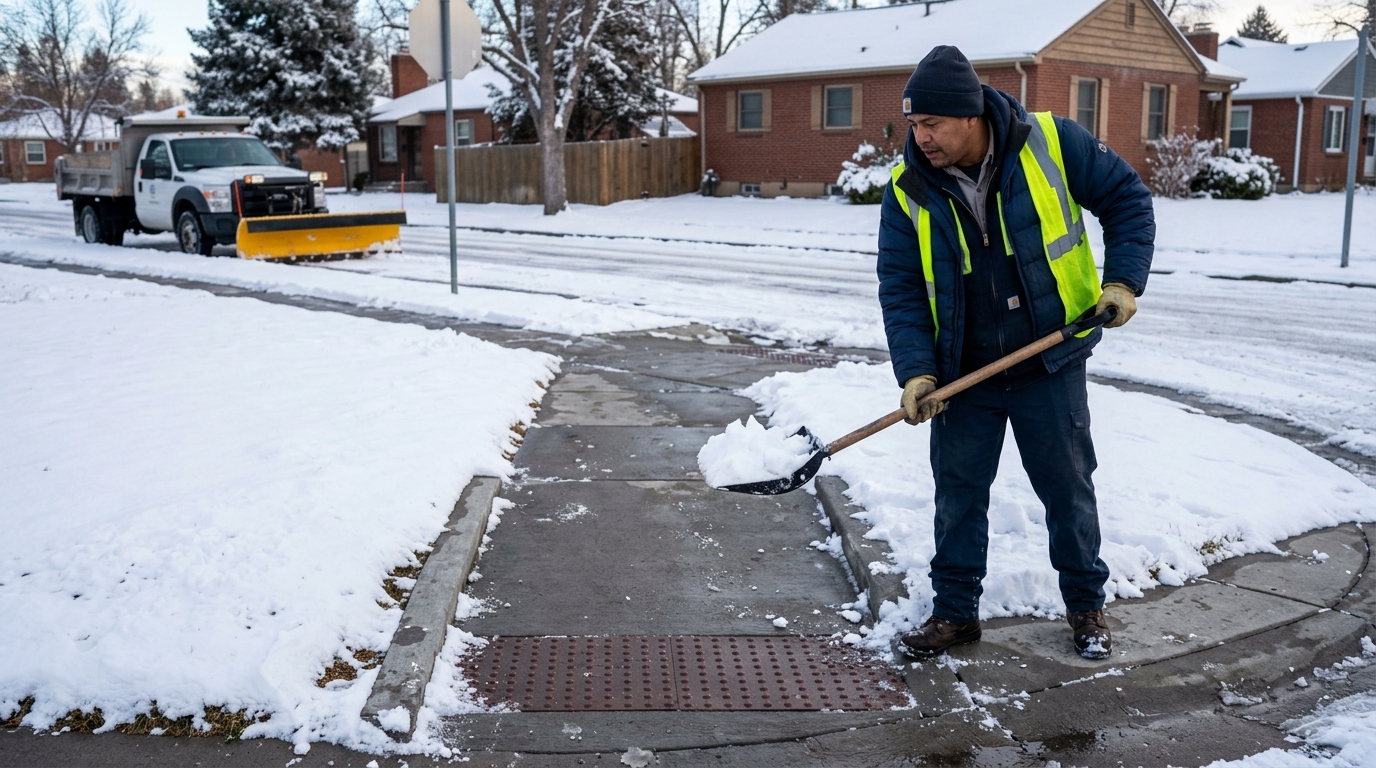
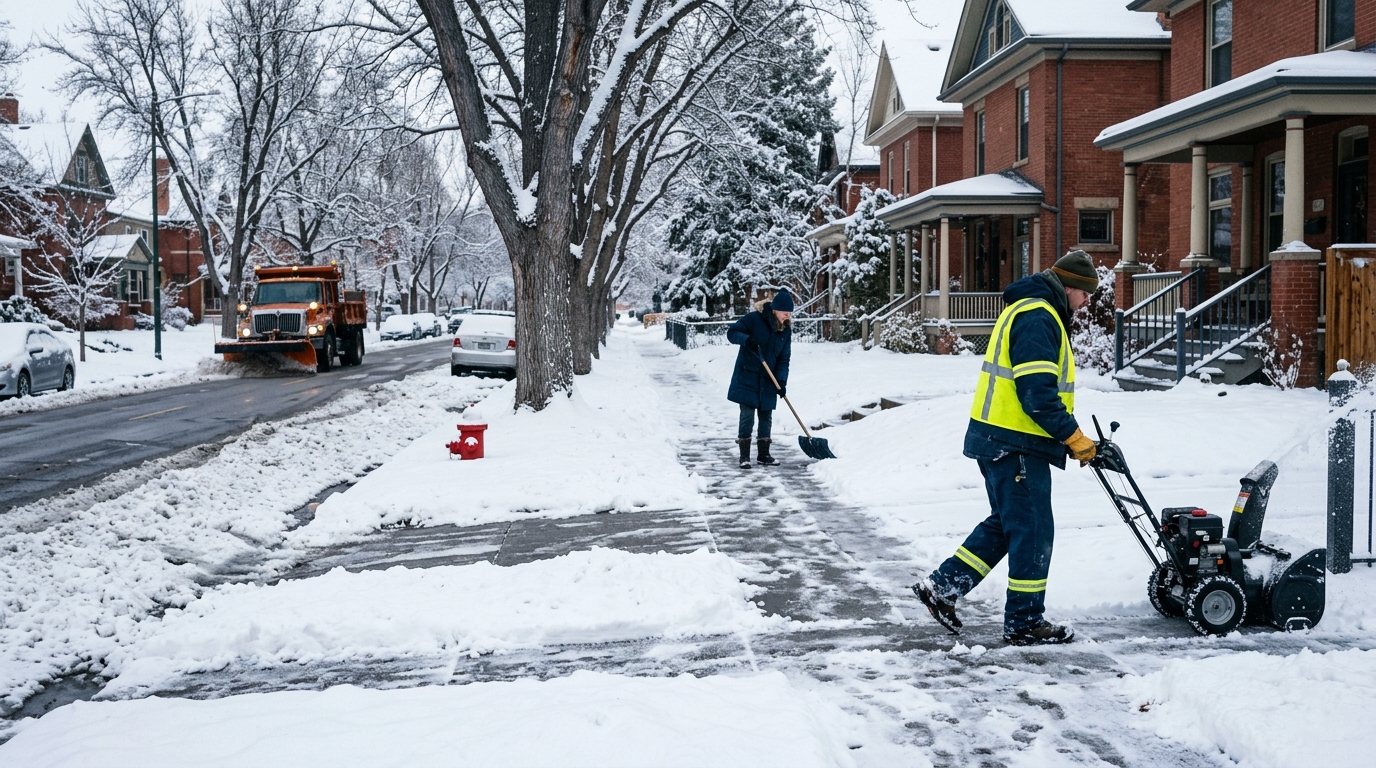
- Clear your sidewalk. The city’s position is that property owners clear snow and ice from their sidewalks, including adjacent ADA ramps and bus stops. Businesses are expected to start right away and residences by the next day. We cover the details in our guide to the Denver sidewalk snow removal law and 2026 rules for property owners.
- If the plow berm blocked your driveway or walk, that’s still yours to clear.
Landlords, HOA boards and managers face the added problem of doing this across many frontages at once. That’s where documented service helps, and it’s why owners look at snow removal services in Denver, CO for homes, HOAs and commercial properties before the first storm instead of during it. A crew that arrives within a couple of hours, with photo proof of each visit, turns a stressful morning into a checked box.
Whatever you do at the curb, remember the street and the sidewalk are two different obligations. Moving your car satisfies one. Shoveling satisfies the other.
Where Denver’s Rules End and Aurora’s or Other Cities’ Begin
Denver’s rules apply inside the City and County of Denver, and they stop at the boundary. Aurora, Boulder, Littleton, Lakewood and Centennial each run their own snow rules, and they aren’t interchangeable with Denver’s. Aurora, for example, gives residents 48 hours in an emergency, according to a roundup of sidewalk shoveling rules. A timeline that’s fine in one city can be a violation in the next.
This matters most for people who live in one place and work or park in another. If your commute crosses a city line, check the rules for each jurisdiction you pass through. Don’t carry Denver’s habits across the border, and don’t assume a neighbor’s advice about "the ban" applies to your street.
It also matters for anyone reading generic snow emergency advice online. A good share of what turns up for this topic describes other cities entirely. The general concept transfers, but the declaration process, the signed routes and the penalties are local. For Denver, the dependable references are the city’s own channels and the signs on your block.
We serve Denver County only, which keeps our own advice honest. We don’t guess at another city’s ordinance, and we’d rather point you to the right local authority than blur the lines. If you want to understand how crews are chosen and compared before a storm hits, our guide on how to compare snow removal crews in Denver in 2026 walks through what to ask, and the next storm is a lot easier when that decision is already made.