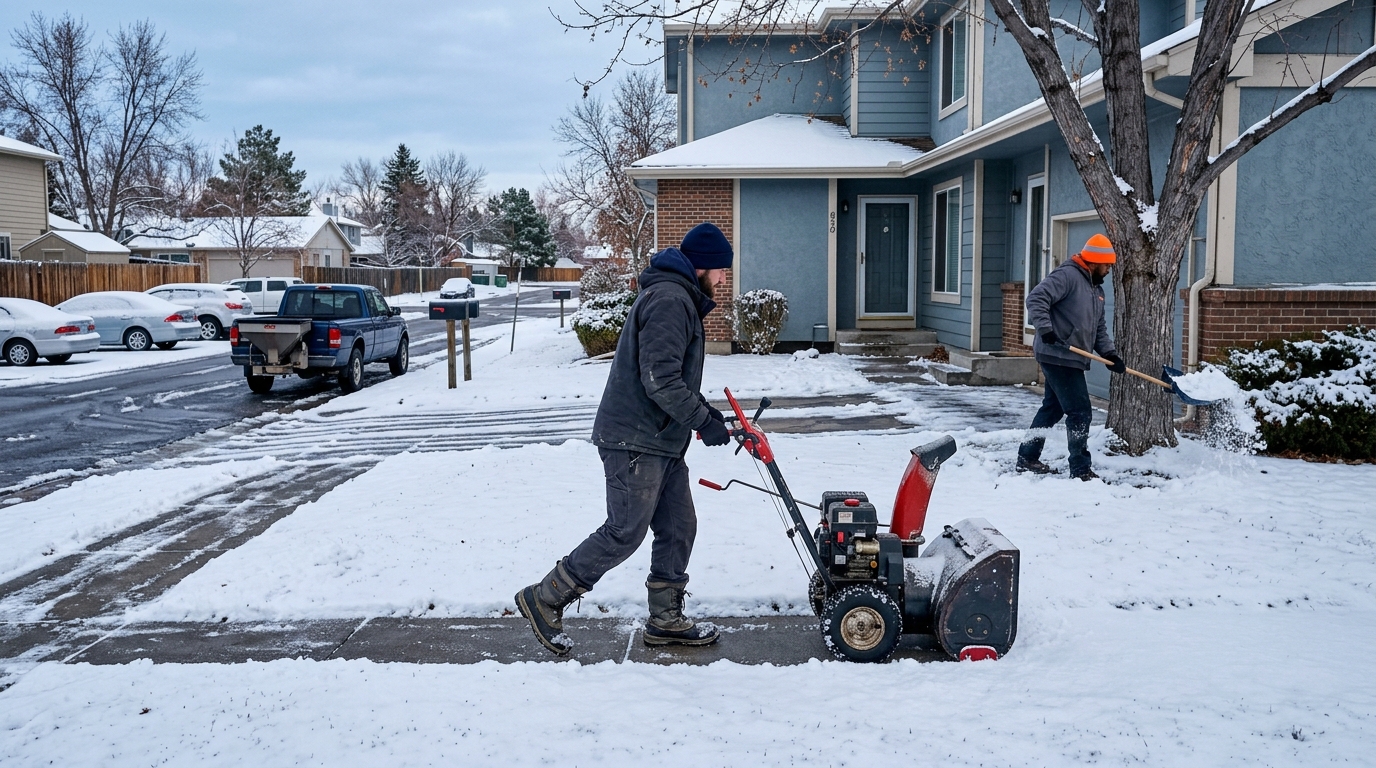
A driveway still buried at 8 a.m. usually has a reason behind it, and that reason is rarely the storm itself. Snow totals in Denver are rarely the whole story. What separates a property that gets cleared in a couple of hours from one that waits until noon is almost always something decided weeks earlier: the route, the contract language, the equipment staging, and how many other properties are competing for the same truck.
Spotting those problems before the season starts is far easier than fixing them during a blizzard. Here are the red flags that consistently show up when clearing runs late, and the questions that expose them.
Why a Slow Clear Starts Before the First Flake
Denver’s Department of Transportation & Infrastructure (DOTI) treats emergency snow response as a planned operation, describing its work as efficient, effective and fiscally responsible, with a response plan built to be proven and economical for normal winter weather conditions. The lesson for private property is simple: the plan matters more than the plow.
Providers that clear driveways, sidewalks, porches and commercial lots get the same benefit from planning ahead. Routes get built before the storm, equipment gets staged, and de-icing material gets loaded while the forecast is still a forecast. A company that starts assembling its route after the first flakes land is already behind before it reaches your block.
The distance problem inside a storm
When a company covers a wide metro area, a single truck may be scheduled for a central Denver neighborhood, then a distant suburb, then back north again. Highways turn into parking lots during a blizzard, and that return trip can double the time between stops. A crew working Denver surface streets inside the county completes more stops per hour, which means the second and third properties on the route get cleared much closer to the first. If the coverage map stretches from the southern suburbs to the northern suburbs, ask what that means for your position in the queue at 3 a.m.
Red Flag 1: A Service Area That Is Never Pinned Down
Vague coverage language is the most common source of a slow clear. Denver metro can mean almost anything, and a provider that will not list specific cities and neighborhoods is usually a provider that has not thought carefully about routing.
- Which cities and neighborhoods do you serve, by name?
- Do your trucks use I-25 or I-70 during an active storm?
- How many properties are on a single route, and how are they ordered?
- What is your committed arrival window after snow begins?
If the answer to the highway question is yes, your clearing time depends on interstate conditions you have no control over. Providers that stay inside the City and County of Denver and the immediately adjacent communities, roughly within ten miles of downtown, remove that variable entirely.
Red Flag 2: Pricing That Moves With the Weather
Price structure shapes behavior. A per-push arrangement pays the provider for showing up, which aligns incentives with your driveway. Hourly arrangements can be perfectly fair, but they put the provider’s incentive somewhere other than a fast finish.
Public listings around Denver show how wide the range runs. One residential listing advertises an $85 package covering front entryways, the city sidewalk and the driveway. Independent task workers average around $44 an hour for snow removal in Denver. Reddit users in a Denver shoveling thread have described quotes of $150 or more for a single visit. None of those numbers are wrong on their own, but they should tell you something is off when a quote arrives with no explanation of what triggers a visit or what happens during a heavy storm.
For typical Denver County residential work, per-push pricing in the $35 to $85 range is common. Ask what happens when a storm drops far more snow than forecast, and get the answer in writing before the first snowfall.

Red Flag 3: No Photo or GPS Proof of Work
You should never have to guess whether a crew showed up. Ask how the company documents service, and look for timestamped photos before and after the work, plus GPS-tracked logs that record when a truck arrived and left. That documentation settles billing disputes, helps HOA boards answer resident complaints, and gives property managers something concrete to forward to owners.
A provider that cannot describe its proof-of-service process is a provider that expects you to take its word for it. In a season where a single missed visit can mean a slip-and-fall claim, that is a thin foundation.
Red Flag 4: De-Icing Treated as an Afterthought
Plowing removes snow. Ice is what sends people to the hospital on stairs, porches and walkways, and ice does not care that the driveway looks clean. Ask what material gets applied, whether it is pet-friendly, and whether it is corrosive to concrete, landscaping or vehicles. Non-corrosive options such as pet-friendly Ice Slicer exist, and the choice matters for households with dogs and for properties with sensitive hardscaping.
Just as important: ask whether de-icing happens on the same visit. If a crew has to make a second trip for ice, your wait doubles and the stairs stay slick in between.
Red Flag 5: Contracts That Skip the Practical Details
A snow contract should answer ordinary questions in plain language. What counts as a visit? What time does the crew arrive? What happens if a car is parked in the driveway? Where does the snow get piled? Who clears the public sidewalk? How do you report a missed stop, and how fast does someone respond?
Commercial and HOA accounts carry more of these moving parts. Parking lots, walkways and entrances often need clearing before the morning commute, which means a 4 a.m. start for retail, office and multi-family properties. A response window of two to four hours belongs in the agreement, not in a verbal promise.

Red Flag 6: No Live Person During the Storm
Test the phone line before you sign anything. Call on a quiet Tuesday afternoon and see who answers. Then ask who dispatches at 2 a.m. during a storm, and whether that number reaches a live person or a voicemail box.
Snow removal runs around the clock, so 24/7 availability should mean exactly that. Emergency and same-day requests are part of the job in Denver, and they are precisely the calls that fail when a company is understaffed or routing from out of state. Longevity helps here. A family-owned Denver operation that has been running since 1974 has already worked through the city’s unpredictable winters and knows which streets flood first, which alleys narrow, and which corners ice over before the rest of the block.
Red Flag 7: No Proof of Licensing and Insurance
Ask for a certificate of insurance and current licensing documentation, and confirm the coverage directly with the provider’s insurer rather than accepting a photocopy. Equipment working near vehicles, garage doors, fences and pedestrians carries real risk, and the paperwork should match the size of the job.
Property owners with specific questions about local requirements can check with the City and County of Denver and their own insurance carrier. Denver’s city snow plan covers streets and public infrastructure, not private driveways, so responsibility for the private side of the property line rests with the owner or the hired provider.

Fast Pre-Season Check for Denver Properties
| Red flag | Question to ask | Reason it matters |
|---|---|---|
| Coverage described only as Denver metro | Name the cities and neighborhoods you serve | Wide coverage often means long, storm-delayed routes |
| Highway travel during storms | Do your trucks use I-25 or I-70 in a blizzard | Highway backups push your clearing back hours |
| Vague pricing triggers | What snowfall amount triggers a visit | Prevents surprise invoices and no-show visits |
| No documentation | Show me a timestamped before and after photo | Proof settles billing and liability disputes |
| Ice handled separately | Is de-icing included on the same visit | A second trip doubles the wait on slick steps |
| No live dispatch overnight | Who answers the phone at 2 a.m. | Storms do not wait for business hours |
What Denver’s Own Snow Plan Sets as the Standard
DOTI handles emergency snow response for city streets with a response plan the department describes as proven and economical for normal winter weather conditions in Denver. That phrasing is the useful part. A good plan assumes normal Denver winter weather, not a best-case forecast, and builds in enough routing discipline to keep moving when conditions worsen.
Private snow removal operates on a smaller scale with the same logic. Stage equipment, plan routes around realistic drive times on surface streets, handle de-icing on the first pass, and document the work. Providers that do all four tend to clear properties in a couple of hours. Providers that skip one of them usually leave you standing at the window.
Frequently Asked Questions
What is the biggest red flag in a Denver snow removal contract?
A service area described only as Denver metro, combined with trucks that travel highways during storms. That combination means your clearing time depends on interstate traffic you cannot influence. Ask for named cities and neighborhoods, then ask directly whether crews use I-25 or I-70 in a blizzard. A provider working Denver surface streets inside the county can give you a reliable arrival window.
How fast should a snow removal crew arrive after a storm?
A response window of two to four hours is realistic for properties inside Denver County and the immediately adjacent communities. Anything longer should be stated up front rather than discovered at 10 a.m. Get the window in writing, along with the snowfall amount that triggers a visit, so expectations match on both sides before the season starts.
Is per-push or seasonal pricing better in Denver?
It depends on how predictable your needs are. Per-push pricing, commonly in the $35 to $85 range for Denver County residential work, keeps costs tied to actual storms. Seasonal contracts suit HOAs, commercial lots and households that want one fixed number. Ask what each option includes for de-icing, sidewalks and stairs before comparing the totals.
Do I need to be home when the crew clears my property?
Usually not, but access details should be settled in advance. Tell the provider about gate codes, dogs, and cars that normally sit in the driveway. Ask where snow will be piled so it does not block a neighbor’s walk or a garage door. Timestamped photos before and after give you confirmation without being home.
How do I verify that a snow removal company is insured?
Request a certificate of insurance and confirm the coverage directly with the insurer listed on it. Ask whether the policy is current for the coming season, since renewals change. Licensed and insured providers expect the question and answer it quickly. If a company hesitates or cannot produce documentation, that hesitation tells you what a busy February morning would look like.
Most slow clears trace back to a decision made in October, not a flake that fell in January. Pin down the service area, the response window, the pricing trigger, the de-icing plan and the proof-of-service process, and you have removed nearly every reason your driveway would sit buried while the rest of the block is already clear.