Ask anyone who has waited on a driveway at 6 a.m. after a heavy Front Range snow. The truck that was supposed to arrive at 4 a.m. is somewhere on I-25, or pinned behind a closure on I-70, or working a route that started in a far south suburb and still has three more cities to finish before it reaches your block. A Denver County-only snow removal route works differently by design, and that difference is the entire reason the service exists.
Denver Snow Removal at denversnow.com, operated by MileHiSnow, has served City and County of Denver addresses since 1974. The service area is deliberately small: the City and County of Denver, Glendale, Edgewater, Englewood, East Lakewood, and West Aurora within 10 miles of downtown. Nothing beyond that line, and no highway travel during blizzard storms. Here is why that constraint works in your favor.
What Denver County-only snow removal actually means
A county-only contractor draws a hard boundary. If reaching a property during a storm would require running I-25 or I-70, that property is not on the schedule. That single rule shapes everything else about how the route performs on a snow day.
The out-of-bounds list matters as much as the in-bounds list. Brighton, Centennial, Parker, Castle Rock, Longmont, and Commerce City north are all outside the boundary, along with any address that sits more than 10 miles from downtown Denver.
- Inside: City and County of Denver neighborhoods such as Capitol Hill, Wash Park, Highlands, Cherry Creek, and Central Denver
- Inside: Glendale, Edgewater, Englewood, East Lakewood, and West Aurora within 10 miles of downtown
- Outside: Brighton, Centennial, Parker, Castle Rock, Longmont, and Commerce City north
- Outside: any route that depends on interstate travel while a storm is still falling
The trade-off is straightforward. Fewer square miles per truck means more passes per driveway, per storm, per customer. When a route covers a compact group of Denver surface streets instead of a 40-mile arc across the metro, the truck spends its hours plowing and almost none of them driving between jobs.
Why a county-only route shows up faster
Denver Snow Removal runs a 2 to 4 hour response window on Denver County properties. That number holds up because the trucks never leave the county in the first place. There is no interstate leg to sit through, no closure advisory to check, and no chain of suburbs between the last job and the next one.
During a storm, the differences stack up quickly. A metro-wide crew that has to cross the metro to reach its next stop absorbs every slowdown on the way. A crew working surface streets inside the county deals with local traffic signals, residential blocks, and alley access, all of which it already knows. Routing is hyper-local by necessity, and the drivers learn which blocks drift, which alleys clog, and which driveways need a second pass when the wind picks up.
Metro-wide crews and the capacity problem
Snow contracts are typically arranged before the season, often from late summer through autumn. By the time the first real storm lands, capacity at most metro-wide companies is already committed. That is worth understanding before you start calling around in January.
The practical result is a route list that gets worked in priority order. A company covering the entire metro has dozens of distant stops competing for the same trucks. Customers at the edge of that footprint, or customers who signed on late, tend to sit at the bottom of the list when the snow keeps falling and the clock keeps moving.
A county-only operation has a shorter list and a tighter geography. When new snow arrives mid-storm, the decision about who gets a second pass is made across a small map, not across four counties.
Denver’s sidewalk rules make the response window matter
Denver enforces sidewalk snow clearing through inspection. For commercial properties, the city enforces sidewalk clearing with a time-stamped notice, and once a property has been noticed, the window to comply is measured in hours rather than days. That is not enough time to start searching for a contractor after the storm has already passed.
What the city expects from property owners
Denver’s guidance says homeowners must remove snow along sidewalks, and the city’s website notes that clearing also includes the areas around mailboxes and fire hydrants. Denver prohibits pushing, plowing, or depositing snow into the street. If you need the exact current requirement or fine schedule for your property, confirm it with the City and County of Denver directly rather than relying on a neighbor’s summary.
Why a short compliance window favors a local crew
A property that gets noticed needs someone on site fast. That is where a Denver County-only provider has a structural advantage: the crew is already in the neighborhood, the route notes for that address already exist, and the response does not depend on a truck getting through interstate traffic to arrive. Speed here is not a marketing claim, it is a scheduling reality created by a small map.
Residential service: driveways, sidewalks, porches, and stairs
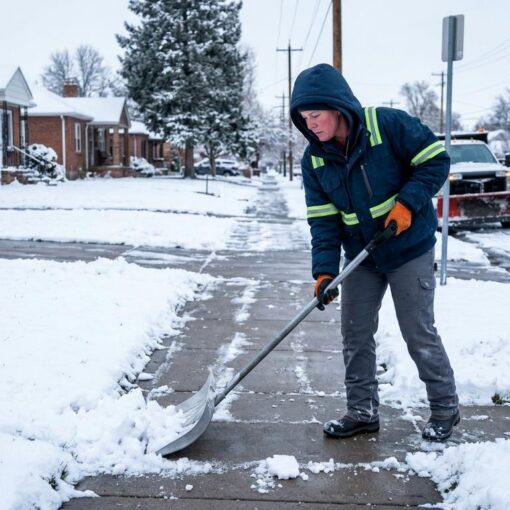
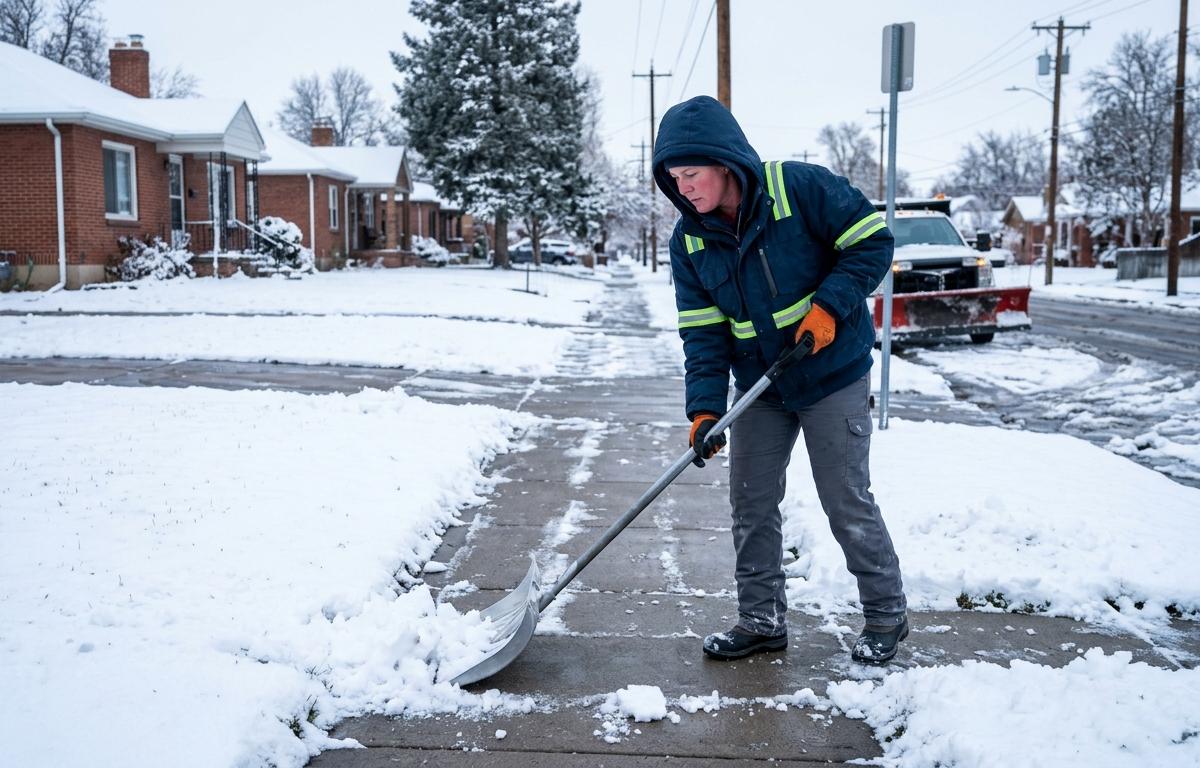
Residential work inside the county covers the full path a person actually walks. That means driveway clearing, sidewalk clearing along the frontage, porch and entry clearing, and stairs. Per-push pricing generally runs $35 to $85 depending on the property, and seasonal contracts are available for homeowners who want the work locked in before winter.
The 24/7 scheduling matters most when the snow does not stop. Instead of one pass that gets buried by mid-afternoon, residential customers on a county-only route get revisited while the storm is still active.
Commercial and HOA service on a 4 a.m. clock
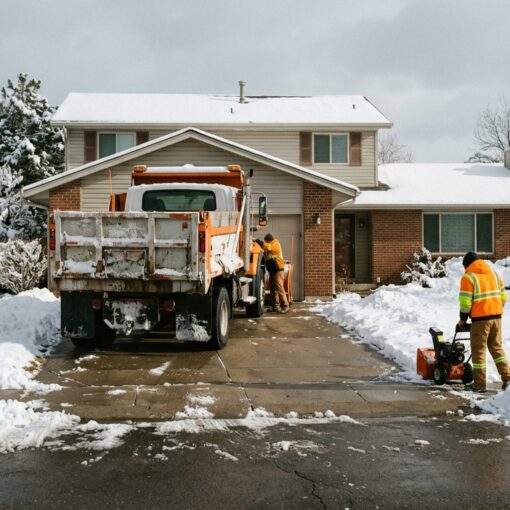
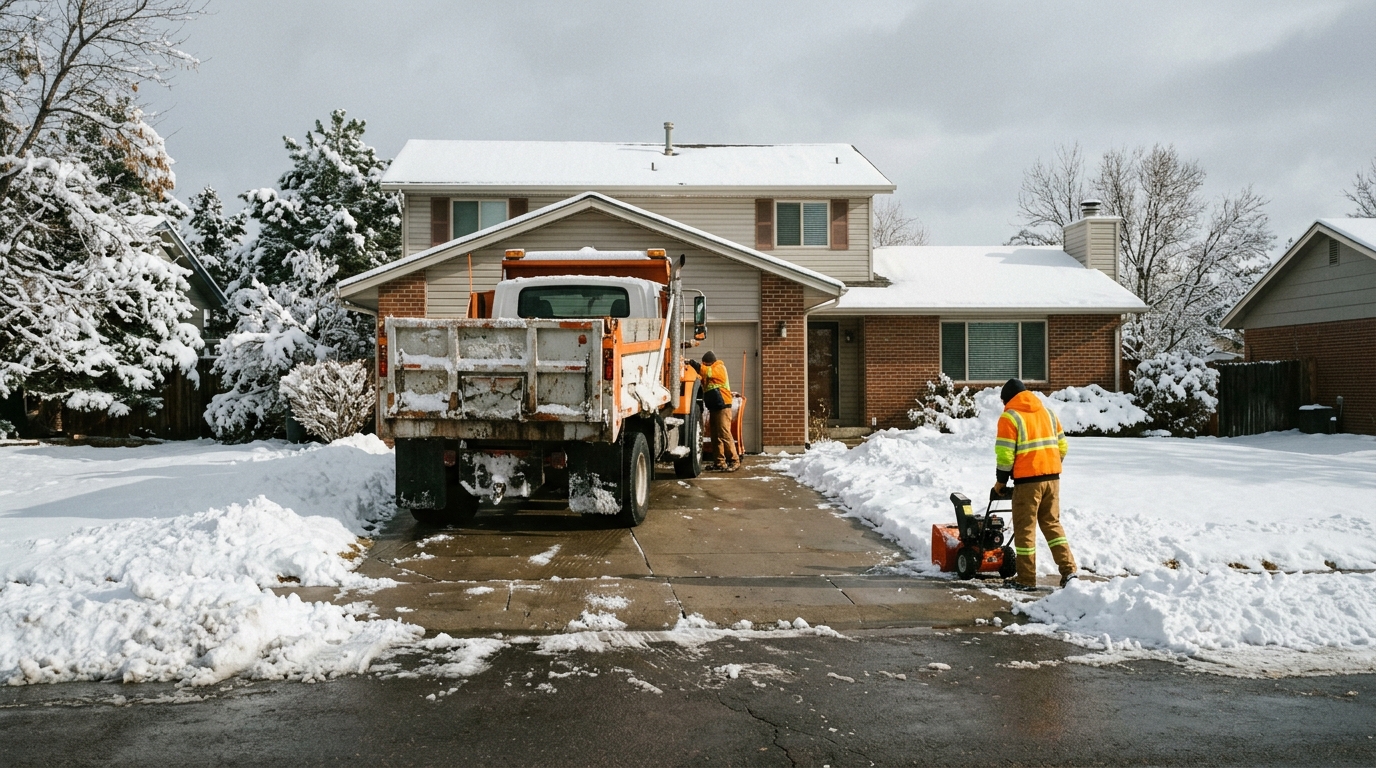
Commercial properties and HOA communities are running a different schedule. Parking lots, walkways, and entrances need to be clear before tenants, employees, and residents start arriving. Denver Snow Removal starts commercial and HOA work at 4 a.m. for exactly that reason.
For HOA boards and property managers, the value is a single point of contact for plowing, walkway clearing, and de-icing, all handled inside the county boundary. De-icing is treated as part of the job rather than an afterthought, which matters on north-facing walkways and shaded entries where meltwater refreezes overnight.
De-icing and ice melt that stays inside the county
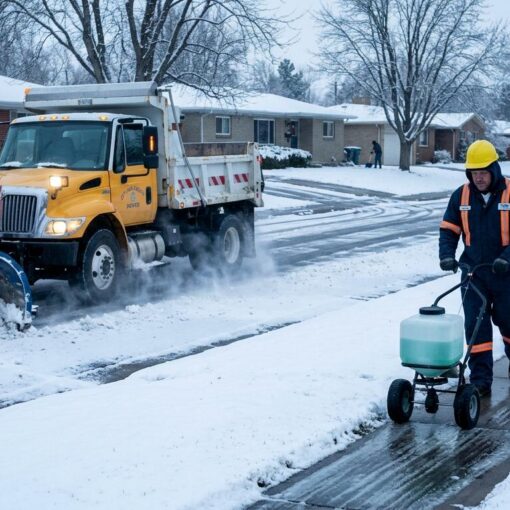
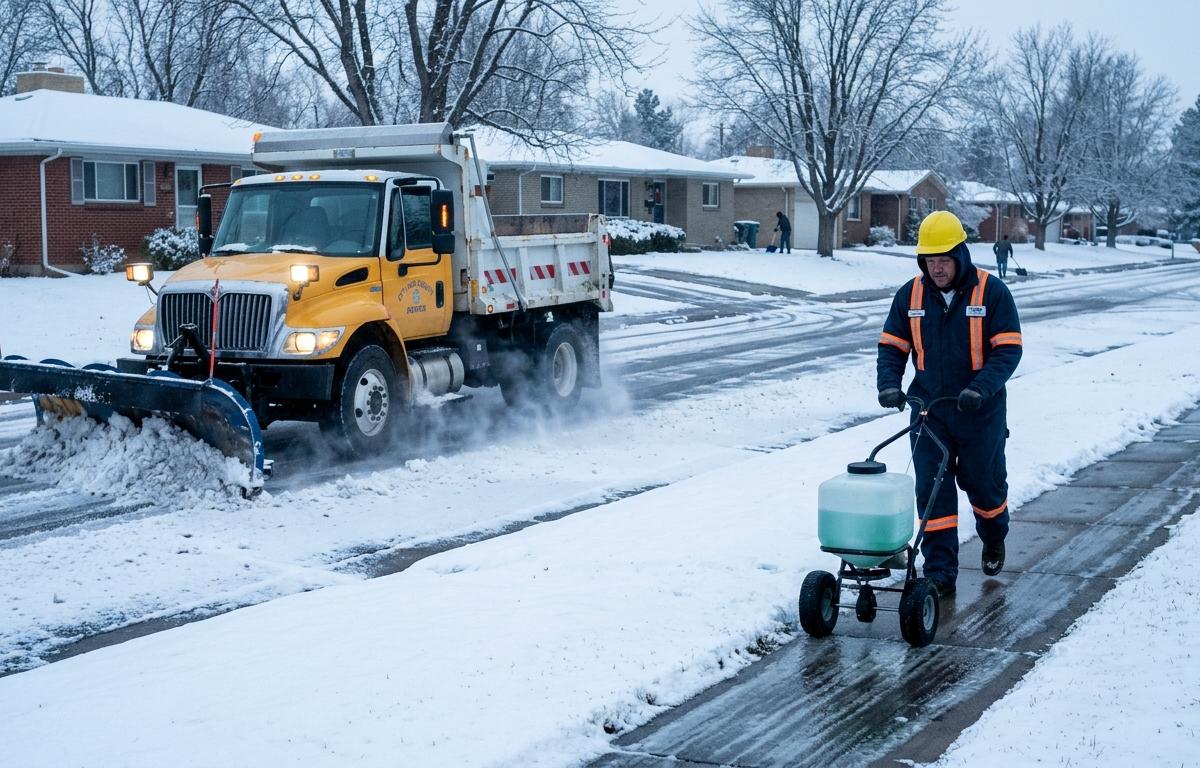
De-icing and ice melt service is available for both residential and commercial properties in the Denver County service area. The product used is a pet-friendly Ice Slicer, and it is non-corrosive, which matters for concrete, metal railings, and paws.
Ice is the part of winter that causes the most slip-and-fall problems, and it usually appears after the plow has already come through. Treating walkways, entries, and stairs on the same visit as the plowing keeps the whole property usable rather than just the driveway.

Proof of service: GPS tracking and timestamped photos
Every job is logged. Routes are GPS tracked, service records are timestamped, and photo proof is captured before and after the work. For a homeowner, that means knowing the driveway was actually cleared at 5 a.m. if it looks drifted again by noon. For a property manager or HOA board, it means documentation attached to the service call.
That documentation is useful well beyond peace of mind. When a sidewalk notice or a slip claim comes up, a timestamped record of when the property was serviced and what condition it was left in carries more weight than a verbal account.
How the two service models compare
| Factor | Denver County-only crew | Metro-wide crew |
|---|---|---|
| Coverage area | Denver County surface streets within 10 miles of downtown | Multiple suburbs across the metro |
| Storm-day travel | Local streets only, no interstate legs | Frequently includes I-25 and I-70 corridor travel |
| Response window | 2 to 4 hours on Denver County properties | Varies with route position and committed capacity |
| Routing style | Hyper-local, same neighborhoods every storm | Broad route spanning many municipalities |
| Service documentation | GPS tracking and timestamped before and after photos | Varies by company |
Is your address inside the Denver County-only boundary?
The service area covers the City and County of Denver along with Glendale, Edgewater, Englewood, East Lakewood, and West Aurora within 10 miles of downtown. If your property sits in one of those areas, you are inside the route.
If you are in Brighton, Centennial, Parker, Castle Rock, Longmont, or Commerce City north, the honest answer is that this service is not built for you, and a crew promising otherwise is likely to be the one stuck on the highway when you need it most. Ask directly before booking, and get a straight answer about where the trucks actually work.
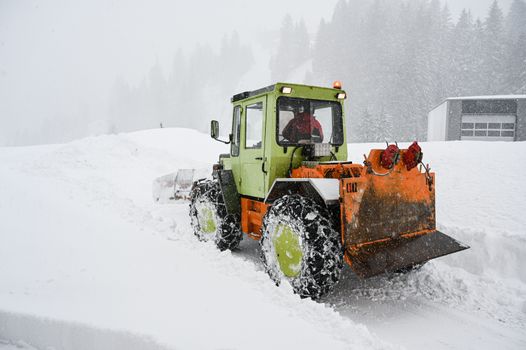
Who clears the street in front of your house
That part is not a contractor’s job. Emergency snow response on Denver streets falls to the city’s Department of Transportation and Infrastructure, which runs a snow response plan for normal winter conditions. The published plan notes that pre-treating streets occurs between 3:00 a.m. and 3:00 p.m.
Residents with questions about a specific street can call 3-1-1, or (720) 913-1311 from outside Denver. The separation matters: the city handles the roadway, and a private contractor handles your driveway, sidewalks, porches, stairs, parking lot, and entryways.
Booking before the first storm
Capacity across the metro is set before the season starts, which is why the most reliable time to arrange service is late summer through autumn. Denver Snow Removal is family owned and has been operating since 1974, with licensed and insured crews working exclusively inside the county boundary.
If you are reading this mid-winter, it is still worth asking about availability and same-day or emergency service. A county-only route has fewer customers per truck mile than a metro-wide operation, which means there is more room to fit a new Denver County property onto the list.
Frequently Asked Questions
Do you charge extra to travel outside Denver County?
No, because the service does not travel outside the county. Denver Snow Removal works strictly in the City and County of Denver plus Glendale, Edgewater, Englewood, East Lakewood, and West Aurora within 10 miles of downtown. Properties in Brighton, Centennial, Parker, Castle Rock, Longmont, and Commerce City north are outside the boundary and are not serviced.
How fast will someone reach my driveway?
The response window on Denver County properties is 2 to 4 hours. That estimate holds because crews stay on local surface streets and never depend on interstate travel during a storm. When snow continues falling, properties get revisited so a single pass does not get buried by mid-afternoon.
Who is responsible for clearing the street itself?
The City and County of Denver handles roadway snow response through its Department of Transportation and Infrastructure. The city’s published plan notes that street pre-treating happens between 3:00 a.m. and 3:00 p.m. For street-specific questions, call 3-1-1, or (720) 913-1311 from outside Denver.
Can I sign up in the middle of winter?
It is worth asking. Snow contracts are typically arranged from late summer through autumn, and by the first storm most metro-wide companies have already committed their capacity. A county-only route carries fewer stops per truck, so there is often room to add a Denver County address during the season or for emergency and same-day service.
Do you provide proof the work was done?
Yes. Routes are GPS tracked, service records are timestamped, and before and after photos document the condition of the property. Homeowners get confirmation of when the work happened, and property managers or HOA boards get documentation they can attach to a service call if a sidewalk notice or slip question comes up later.
Winter in Denver rewards preparation more than reaction. The homeowners, property managers, and HOA boards who have the smoothest seasons are the ones who locked in a crew before the first storm and chose a route that never has to cross the metro to reach them. Staying inside the county is not a smaller promise, it is a more reliable one, and since 1974 that has been the entire operating model behind Denver Snow Removal at denversnow.com.